An LPR camera — License Plate Recognition camera — is a specialized security camera designed to automatically read and record vehicle license plate characters. Unlike standard surveillance cameras that capture general video footage, LPR cameras are engineered specifically for one task: producing a clear, readable image of a license plate, extracting the plate number, and making that data searchable. Here is how the technology works, why it requires different hardware than standard cameras, what these systems cost, and when you would use one.
LPR, ALPR, and ANPR: What Is the Difference?
Three acronyms describe the same core technology, and they are used interchangeably depending on region and context:
| Acronym | Full Name | Where It’s Used |
| LPR | License Plate Recognition | Standard North American term; most common in US commercial and consumer contexts |
| ALPR | Automated/Automatic License Plate Recognition | North America; emphasizes the automated nature; common in law enforcement technical specs |
| ANPR | Automatic Number Plate Recognition | UK, Europe, Australia, and much of Asia-Pacific; same technology, different regional terminology |
There is no meaningful technical difference between LPR, ALPR, and ANPR. The same camera sold to a US police department may be called an ALPR system; the identical device sold to a UK council may be marketed as ANPR. If you see any of these acronyms, they describe the same type of hardware.
How Does an LPR Camera Work?
LPR cameras process a license plate image through four distinct stages from capture to readable data:
Stage 1: Image Capture
The camera photographs the vehicle’s license plate using a combination of specialized optics and infrared illumination. The key technical challenges at this stage are motion blur (vehicles are moving) and overexposure (license plates are highly reflective). Standard security cameras fail at this stage because their auto-exposure systems try to balance the entire frame — when a reflective plate is the brightest object in the image, the camera overexposes it into an unreadable white blob.
LPR cameras solve this through:
- High shutter speeds: Professional LPR systems use shutter speeds of 1/1000 second or faster — sufficient to freeze a plate moving at highway speeds without motion blur. Consumer-grade LPR cameras handle speeds up to about 18 mph; commercial systems are rated for speeds up to 155 mph
- Wide aperture lenses: F1.0 to F1.4 apertures allow enough light in low conditions while maintaining fast shutter speeds
- Optical band-pass filter: This filter blocks wavelengths outside a specific range, reducing glare from headlights and sunlight that would otherwise wash out the plate
- Infrared illumination: IR LEDs operating at 880nm or 940nm wavelength flood the plate zone with invisible light. This wavelength is invisible to human eyes but highly effective at illuminating the retroreflective material used in most license plates worldwide, producing a high-contrast black-and-white image regardless of ambient lighting
Stage 2: Plate Detection
Software algorithms scan the captured image to locate the license plate within the frame. This involves identifying the rectangular plate boundary against the surrounding vehicle body. Modern systems use neural networks trained on millions of plate images to locate plates reliably even when partially obscured, at angles, or in poor weather.
Stage 3: Character Recognition (OCR)
Once the plate area is isolated, optical character recognition (OCR) software segments the plate into individual characters and identifies each one. The system accounts for variations in plate fonts, colors, layouts, and jurisdictions — a US system processes dozens of different state plate designs; a global system must handle hundreds of different national formats. Advanced systems use machine learning models that continue improving accuracy as they process more plates.
Stage 4: Database Comparison and Action
The extracted plate number is compared in real time against one or more databases. Depending on the application, this might trigger: a gate opening for an authorized vehicle, an alert for a stolen vehicle flagged on a hotlist, a parking violation record, a toll payment charge, or simply a searchable log entry for later investigation. The total time from camera capture to database comparison is typically under one second in modern systems.
Why Regular Security Cameras Don’t Work for License Plates
The single most important insight about LPR cameras: a standard 4K security camera is not a substitute, particularly at night. According to CCTV Info’s 2026 guide, a regular 4K camera works during the day at slow vehicle speeds but fails completely at night. The reason is the reflective plate overexposure problem described above — without the optical band-pass filter, the specialized IR illuminator, and the high shutter speed, the plate becomes an unreadable white blob in the camera’s image at night, regardless of the camera’s megapixel count.
The Reolink CX410 at approximately $220 is cited as the cheapest ‘serious’ LPR option that addresses these challenges. Below that price point, results in real-world conditions are inconsistent — particularly at night and with moving vehicles.
LPR Camera Pricing: What to Expect in 2026
| Category | Price Range | Examples and Notes |
| Consumer / Home LPR | $150–$400 | Reolink CX410 (~$220) — best consumer entry; Avalonix ANPR cameras; requires NVR or cloud software for full LPR function |
| Prosumer / Small Business | $400–$1,200 | Dedicated IP LPR cameras; PoE-powered; higher capture speed; compatible with ONVIF NVRs |
| Professional / Commercial | $1,200–$3,000+ | Pelco L6Q, Avigilon, Hanwha; full analytics; multi-lane support; enterprise VMS integration |
| Law Enforcement / Enterprise | Subscription + hardware | Flock Safety, Vigilant (Motorola Solutions), Axis ANPR; solar+LTE options; network-based access to shared plate databases; quote-based pricing |
An important distinction: most LPR cameras require accompanying software to function as a plate recognition system. The camera hardware captures the image; LPR software (either on an NVR, on the camera’s edge processor, or in a cloud subscription) performs the OCR and database comparison. A dedicated LPR camera without compatible software functions only as a high-specification security camera.
Types of LPR Camera Systems
Fixed LPR Cameras
Fixed cameras mount permanently at a specific location — a driveway entrance, a parking lot gate, a toll plaza, or a road chokepoint. They capture every vehicle that passes through their field of view. Fixed systems are the most common deployment type and are used for everything from neighborhood gate access to highway tolling.
Mobile LPR Cameras
Mobile LPR systems mount on vehicles — most commonly police cars, repo trucks, and parking enforcement vehicles. The cameras scan plates of parked and passing vehicles automatically as the vehicle drives down a street. A single patrol car with a mobile LPR system can process hundreds of plates per hour and cross-reference them against stolen vehicle databases in real time.
Solar-Powered LPR Cameras
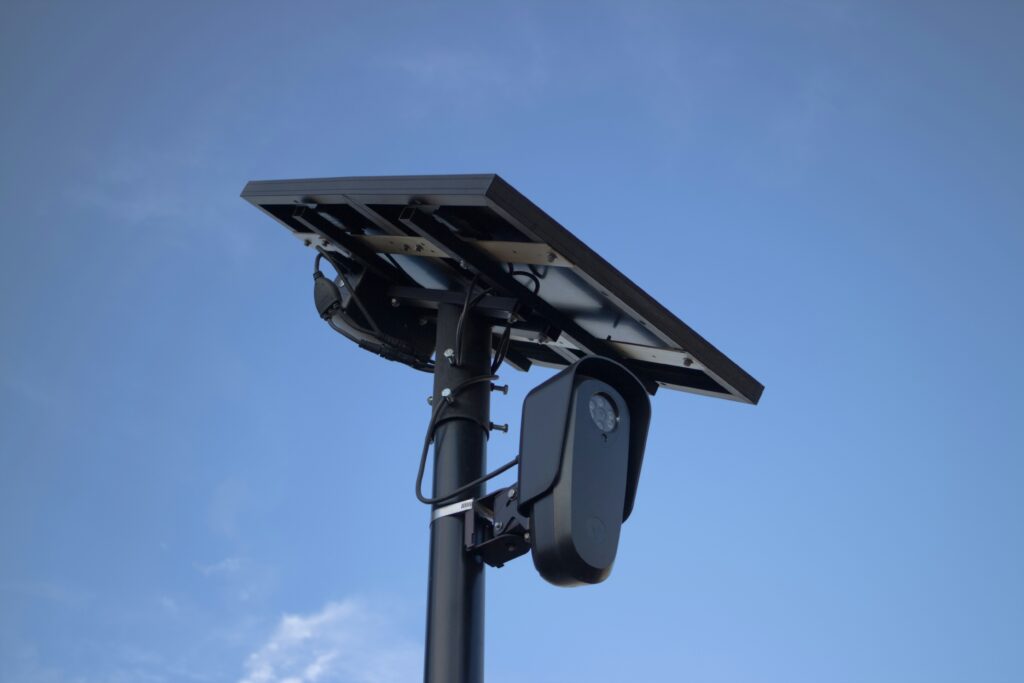
Solar-powered LPR cameras combine solar panels, batteries, and LTE connectivity to create completely infrastructure-independent deployments. Flock Safety’s camera platform is the leading example — solar-powered and LTE-connected, these cameras install in hours at any location without wiring or power connections. They transmit plate data to cloud servers and are widely used by neighborhood organizations, businesses, and law enforcement agencies. Pricing is subscription-based.
Handheld LPR Devices
Portable handheld units used by law enforcement, parking enforcement officers, and repo agents. They function as the same LPR technology in a handheld form factor — point the device at a plate, the system reads it and cross-references databases instantly.
LPR vs LPC: License Plate Capture vs Recognition
Two related terms are sometimes confused:
- LPR (License Plate Recognition): The camera captures the image AND the system reads the characters via OCR and compares them against databases. Full read-and-recognize functionality
- LPC (License Plate Capture): The camera captures a clear image of the plate but does not have built-in OCR or database functionality. The image is stored for later manual review or is processed by separate software
Consumer-grade ‘LPR cameras’ sold for home use are often technically LPC cameras — they capture a good plate image but require a compatible NVR or cloud service with OCR software to actually read and record the plate number as searchable text. When evaluating a camera’s capabilities, verify whether OCR is performed on the camera (edge processing), on a compatible NVR, or through a cloud subscription.
LPR Cameras for Home Use
Home use of LPR cameras has grown significantly as hardware prices have dropped. Common residential applications include:
- Driveway monitoring: Recording every vehicle that enters the property with a searchable plate log
- Gate access control: Automatically opening gates for recognized plates (family vehicles, regular visitors) while logging unknown plates
- Neighborhood security: Neighborhood organizations sometimes pool resources to install Flock Safety or similar cameras at entrances, creating a shared database of vehicle activity
- Package theft deterrence: Capturing clear plate images of vehicles that visit while packages are delivered
For home deployment, the Reolink CX410 (~$220) is the recommended starting point per CCTV Info’s 2026 testing. Optimal mounting for residential driveways:
- Camera height: approximately 1 meter (3.5 feet) from the ground — matching plate height for cars
- Distance from plate: 5-8 meters (15-25 feet) from where vehicles stop
- Angle: As perpendicular (head-on) to the plate as possible; 30° off-axis maximum; side-on positioning makes plates unreadable
- Avoid: Positioning where sunrise or sunset shines directly at the lens; overhead mounting (angle makes plates difficult to read)
LPR Camera Brands and Systems
| Brand | Market Segment | Key Products |
| Reolink | Consumer/home | CX410 (~$220) — entry-level dedicated LPR |
| Axis Communications | Commercial/enterprise | Q1700-LE, P1448-LE; Axis LPR/ANPR cameras; VMS integration |
| Hikvision | Commercial | DS-2CD series LPR; parking and toll applications |
| Pelco (Motorola Solutions) | Commercial/enterprise | L6Q Quick-Deploy; LinC software; solar/AC/battery power options; ~$1,200+ |
| Avigilon (Motorola Solutions) | Enterprise/law enforcement | H5 series; AI-powered analytics; large-scale deployment |
| Hanwha Vision | Commercial/enterprise | XNO-8080R and similar; Korean manufacturer with global reach |
| Flock Safety | Law enforcement/community | Solar+LTE; subscription-based; neighborhood and municipal deployment |
| Vigilant (Motorola Solutions) | Law enforcement | Mobile and fixed LPR for police; national LEARN database access |
Privacy and Legal Considerations
LPR cameras raise legitimate privacy questions that are worth understanding before deploying or interacting with these systems:
- Data retention: Flock Safety retains captured plate data for 30 days by default. Law enforcement and municipal databases may retain data for years
- Public space: In most US states, filming in public spaces (including public roads and streets) is legal for both government and private entities, and license plates on public roads have no legal expectation of privacy
- Database access: Law enforcement LPR databases are increasingly networked — Flock Safety connects municipal cameras into a shared network used by agencies across the country
- Civil liberties concerns: The ACLU and other civil liberties organizations have documented extensive LPR database use by law enforcement, including tracking of individuals’ movements over time. Some states have passed legislation restricting data retention periods and access
- Private property: Deploying LPR on private property (driveways, parking lots, private roads) is generally legal in the US but may be subject to state-specific surveillance notification requirements
Frequently Asked Questions
What is an LPR camera?
An LPR (License Plate Recognition) camera is a specialized security camera that automatically captures vehicle license plate images and uses OCR software to read and record the plate characters as searchable data. LPR cameras differ from standard security cameras in their use of high shutter speeds, infrared illumination, and optical filters specifically designed to produce readable plate images in any lighting condition.
What is the difference between LPR and ANPR?
LPR and ANPR describe identical technology. LPR (License Plate Recognition) is the standard term in North America. ANPR (Automatic Number Plate Recognition) is the standard term in the UK, Europe, and Australia. ALPR (Automated License Plate Recognition) is sometimes used in law enforcement contexts. The hardware and software are the same regardless of the acronym.
How much does an LPR camera cost?
Consumer LPR cameras start around $220 (Reolink CX410). Professional commercial LPR cameras (Pelco, Avigilon, Hanwha) start around $1,200. Law enforcement systems (Flock Safety, Vigilant) use subscription-based pricing. Full systems also require compatible NVR or cloud software for OCR and database functionality — budget for both hardware and software costs.
Can a regular security camera read license plates?
Standard 4K cameras work for plate capture in daylight at slow speeds but fail at night. The reflective license plate overexposes under standard camera auto-exposure when illuminated by headlights or IR, making the plate an unreadable white blob. Dedicated LPR cameras use optical band-pass filters, high shutter speeds (1/1000s+), and specialized IR illumination to solve this problem.
Can I use an LPR camera at home?
Yes — the Reolink CX410 (~$220) is the recommended consumer entry point. Mount at plate height (~1 meter), 5-8 meters from where vehicles stop, with a near-perpendicular angle to the plate. You will also need an NVR with LPR functionality or a compatible cloud software subscription to convert plate images into searchable text data.
What is a solar-powered license plate reader?
Solar-powered LPR cameras combine solar panels, internal batteries, and LTE cellular connectivity to operate without external power or wiring. Flock Safety’s system is the leading example — designed for neighborhood, business, and law enforcement deployment at any location. The solar-powered approach enables installation in hours at locations where running power cables would be impractical.
Final Thoughts
LPR cameras are a genuinely specialized technology — not just security cameras with better resolution, but purpose-built systems designed around the specific optical challenge of reading retroreflective plates in any lighting condition at vehicle speeds. The consumer market has become more accessible, with dedicated units starting around $220, but the hardware is only half the system. Matching the right camera to a compatible NVR or software platform with LPR/OCR capability is as important as the camera itself. For home driveways and small business applications, the positioning recommendations matter more than which specific camera brand you choose — a well-positioned $220 camera will consistently outperform a $500 camera mounted in the wrong location.