
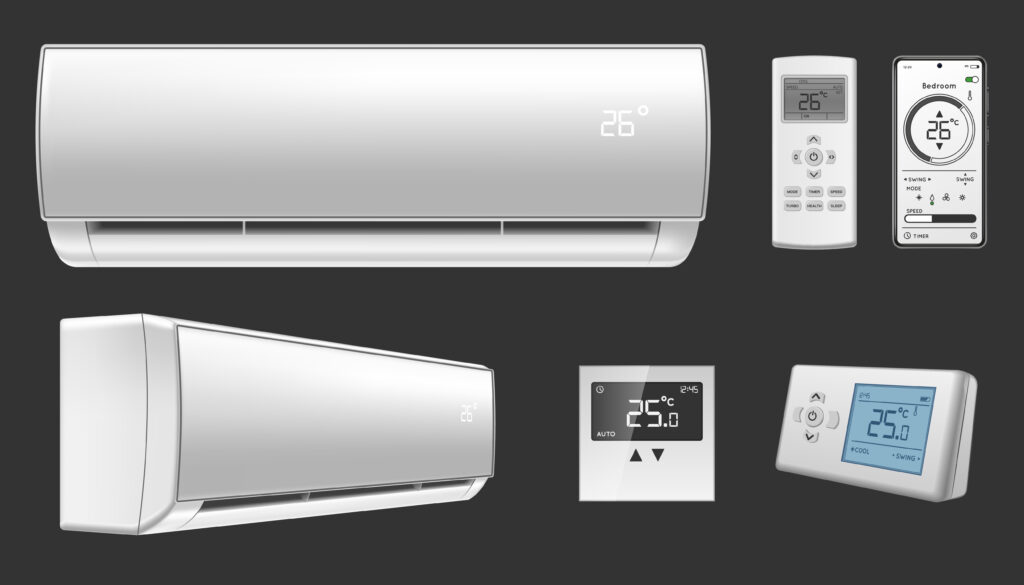
Samsung mini split air conditioners — also called ductless split systems — offer one of the most energy-efficient ways to add climate control to a room, addition, garage, or home without existing ductwork. Samsung’s Wind-Free lineup has established a strong reputation in the US mini split market, and the brand competes directly with Mitsubishi Electric, LG, and Daikin at most capacity and price points. This guide covers everything you need to know before buying a Samsung mini split — BTU sizing, SEER ratings, model selection, smart features, and installation requirements.
For Samsung’s full appliance lineup including washers, dryers, refrigerators, and ovens, see our Samsung vs LG appliances comparison guide which covers the broader Samsung home appliance portfolio.
What Is a Mini Split Air Conditioner?
A mini split (also called a ductless split or ductless mini split) is a two-part air conditioning system consisting of an outdoor compressor/condenser unit and one or more indoor air handler units mounted on walls, ceilings, or floors. Unlike window units, mini splits require no window cutout and no existing ductwork. Unlike central air systems, they do not require a network of air ducts throughout the building.
Mini splits can operate in both cooling and heating mode (as heat pumps), making them year-round climate control solutions rather than seasonal cooling-only installations. Samsung’s Wind-Free models are heat pumps by default, providing both cooling in summer and efficient heating in winter down to specific minimum outdoor temperatures depending on the model.
Samsung Wind-Free Mini Split: What Makes It Different
Samsung’s primary differentiator in the mini split market is its Wind-Free technology, which eliminates the direct cold airflow that many users find uncomfortable with standard mini splits. In Wind-Free mode, the indoor unit draws air through thousands of micro holes in the panel rather than through traditional louvers, creating a diffuse, gentle distribution of conditioned air rather than a direct draft.
- Wind-Free Cooling mode activates automatically once the room reaches the target temperature — the compressor continues running but airflow shifts from direct to diffuse
- Standard cooling mode (louvers open) is available for faster initial cooldown
- Samsung claims Wind-Free technology reduces energy consumption in maintain mode by up to 72% compared with standard louver cooling at the same settings
- Wind-Free is the defining feature of Samsung’s premium mini split tier; budget-tier Samsung mini splits use standard louver designs
Samsung Mini Split Models and Specifications
| Model Series | BTU Range | SEER Rating | Wind-Free? |
| Wind-Free Elite | 9,000–24,000 BTU | Up to 22 SEER2 | Yes |
| Wind-Free Comfort | 9,000–24,000 BTU | Up to 20 SEER2 | Yes |
| Wind-Free Commercial | Multiple capacities | Varies by model | Yes |
| AR24DXFAMWKNCV | 24,000 BTU (2 ton) | Model-specific | Yes — check spec sheet |
Samsung AR24DXFAMWKNCV: Model-Specific Guide
The Samsung AR24DXFAMWKNCV is a 24,000 BTU (2 ton) mini split — one of the larger single-zone residential units Samsung offers. At 24,000 BTU, this unit is sized for spaces roughly 1,000-1,500 square feet depending on ceiling height, insulation quality, and climate zone. The AR24 prefix indicates the 24,000 BTU capacity; the remaining alphanumeric string identifies the specific series, features, and market variant.
Installation requirements for the AR24DXFAMWKNCV
- Electrical: 240V dedicated circuit — most 24,000 BTU mini splits require a 20-30A dedicated circuit depending on the specific model’s current draw
- Line set: 3/8″ and 5/8″ copper refrigerant lines for 24,000 BTU units; line set length affects system performance and installation cost
- Condensate drain: the indoor unit produces condensate (water) that must drain away — typically via a gravity drain or a small condensate pump
- HVAC certification: refrigerant handling requires EPA Section 608 certification in the US — mini split installation involving refrigerant should be performed by a licensed HVAC technician
BTU Sizing Guide for Samsung Mini Splits
Choosing the right BTU capacity for a Samsung mini split is the most important decision before purchase. An undersized unit runs continuously without reaching the target temperature; an oversized unit short-cycles (turns on and off too frequently), creating humidity problems and reducing efficiency.
| Room Size (sq ft) | Recommended BTU | Samsung Model Tier |
| Up to 350 sq ft | 9,000 BTU | Wind-Free 9K |
| 350-700 sq ft | 12,000 BTU | Wind-Free 12K |
| 700-1,000 sq ft | 18,000 BTU | Wind-Free 18K |
| 1,000-1,500 sq ft | 24,000 BTU | Wind-Free 24K (AR24) |
These are starting estimates for standard residential spaces with 8-9 foot ceilings and average insulation. Adjust upward for rooms with high ceilings, large south-facing windows, poor insulation, or in very hot climates. Adjust downward for heavily shaded, well-insulated spaces. When in doubt, consult an HVAC technician for a Manual J load calculation — this is the industry-standard method for precise HVAC sizing.
Samsung Mini Split SEER Ratings and Efficiency
SEER (Seasonal Energy Efficiency Ratio) and the newer SEER2 standard measure how efficiently a mini split converts electricity into cooling capacity. Higher SEER ratings mean lower electricity costs for the same cooling output. Samsung Wind-Free mini splits reach up to SEER2 ratings in the high teens to low 20s depending on the specific model, which places them in the high-efficiency tier of the residential mini split market.
- SEER2 15-17: good efficiency, below Samsung’s Wind-Free premium tier
- SEER2 18-20: high efficiency — Samsung Wind-Free Comfort tier
- SEER2 20+: premium efficiency — Samsung Wind-Free Elite tier
The efficiency premium of high SEER2 models pays back over time through lower electricity bills, but the payback period depends on local electricity rates and how many hours per year the unit runs. In climates with long, hot summers and high electricity costs, the higher upfront cost of a SEER2 20+ unit is typically recovered within 3-5 years through energy savings.
Samsung Mini Split Smart Features
Samsung mini splits connect to Samsung’s SmartThings ecosystem, allowing control through the SmartThings app on any Samsung Galaxy phone or tablet, and integration with Google Home and Amazon Alexa voice control.
- SmartThings app: control temperature, fan speed, Wind-Free mode, and scheduling from anywhere with an internet connection
- Auto Cleaning: Samsung Wind-Free units include a self-cleaning function that runs the fan to dry the indoor coil after cooling operation, reducing mold and bacteria growth
- Weekly scheduler: program temperature and mode changes on a weekly schedule through the app or remote
- Energy monitoring: SmartThings tracks energy consumption for compatible Samsung mini split models
Samsung Mini Split vs Mitsubishi vs LG
| Factor | Samsung | Mitsubishi Electric | LG |
| Brand reputation in HVAC | Growing — strongest consumer brand recognition | Industry standard — most contractor-recommended | Strong — competitive with Samsung on tech features |
| Wind-Free technology | Yes — unique to Samsung | No — uses Hyper-Heating Inverter | No — similar louver-based distribution |
| Low-temperature heating | Good — Wind-Free Elite rated to -13°F | Excellent — Hyper-Heat rated to -13°F | Good — competitive with Samsung |
| Smart features | SmartThings, Alexa, Google Home | kumo cloud app — less consumer-friendly | ThinQ app, Alexa, Google Home |
| Contractor availability | Growing — less established than Mitsubishi | Widest contractor network in US | Growing contractor network |
| Price | Competitive — often lower than Mitsubishi | Premium — typically highest priced | Competitive with Samsung |
Mitsubishi Electric remains the dominant mini split brand among HVAC contractors in the US — its units are widely regarded as the most reliable and the company has the deepest contractor training network. Samsung’s advantage is primarily in consumer-facing smart features, the Wind-Free technology differentiation, and typically lower purchase price at comparable SEER ratings. For buyers who prioritize long-term reliability and contractor support, Mitsubishi is the professional recommendation. For tech-savvy homeowners who value SmartThings integration and Wind-Free comfort, Samsung is a compelling alternative.
Samsung Mini Split Installation: What to Know Before Buying
- DIY installation: Samsung does not recommend DIY refrigerant line installation — US law requires EPA Section 608 certification for refrigerant handling
- Plug-in (pre-charged) units: some smaller Samsung mini splits are available as pre-charged, plug-in units for DIY installation without refrigerant handling — these are available for up to 12,000 BTU and suitable for specific installation scenarios
- Contractor selection: use Samsung’s dealer locator to find authorized Samsung mini split installers in your area
- Permits: most US jurisdictions require a building permit and inspection for mini split installation — check local requirements before installation
For Samsung mini split specifications, model comparison, and authorized dealer location, see the Samsung US air conditioners page. For independent mini split efficiency ratings and SEER2 data, see the AHRI Directory for certified mini split ratings.
Samsung Mini Split Maintenance
Regular maintenance extends the life of a Samsung mini split and maintains its efficiency rating. Samsung’s Wind-Free units include some self-cleaning features, but manual maintenance is still required on a seasonal basis.
• Clean indoor unit filters every 2-4 weeks during heavy use periods — Samsung mini split filters slide out from the front of the indoor unit without tools and can be vacuumed or rinsed under water, then allowed to dry completely before reinserting
• Run the Auto Cleaning function after extended cooling periods — this runs the fan at low speed to dry the internal coil and prevent mold growth
• Inspect the outdoor unit seasonal: clear leaves, debris, and any plant growth from around the outdoor condenser; the unit needs clear airflow on all sides
• Annual professional service: have a licensed HVAC technician inspect the refrigerant charge, clean the coils, and check electrical connections annually — this maintains manufacturer warranty coverage and ensures peak efficiency
Samsung Mini Split Troubleshooting: Common Issues
Samsung mini splits display error codes on the indoor unit’s display panel when faults are detected. The most common:
• E1 / E2: indoor temperature sensor fault — typically requires sensor replacement
• E4: high pressure protection — often caused by a dirty outdoor coil or blocked airflow around the outdoor unit
• E5: overcurrent protection — check electrical supply voltage and circuit amperage
• E9: indoor unit fan motor fault — fan motor may need replacement
For error codes not listed here, Samsung’s mini split service manuals are available through Samsung’s HVAC service portal and through authorized Samsung HVAC dealers. Error code documentation is model-specific — confirming your unit’s model number before looking up codes is important.
Multi-Zone Samsung Mini Split Systems
Samsung offers multi-zone mini split systems that connect multiple indoor units to a single outdoor compressor — useful for cooling or heating multiple rooms without installing separate outdoor units for each zone. Samsung’s multi-zone systems are available in configurations from two-zone to five-zone, with the outdoor unit sized to handle the combined capacity of all indoor units running simultaneously.
Multi-zone systems require more careful BTU sizing and line set planning than single-zone installations, and are generally recommended for professional design and installation rather than DIY. The energy savings from a single efficient outdoor compressor versus multiple separate units can be significant for whole-house or multi-room applications.
Samsung Mini Split vs Window AC Units
For buyers deciding between a Samsung mini split and a traditional window air conditioner, the comparison comes down to installation complexity versus efficiency and comfort. Window ACs are simpler to install (plug in and slide into the window) but are significantly less efficient than mini splits, noisier, less effective at dehumidification, and require the window to remain partially blocked.
A Samsung Wind-Free mini split at the same BTU rating will typically consume 30-50% less electricity than a window unit, provide quieter operation (the compressor is outside), and offer far better humidity control. The higher upfront cost and installation requirement are the trade-offs. For permanent climate control in a room used regularly, a mini split almost always makes better long-term sense than a window unit.
Samsung’s Wind-Free mini split lineup represents one of the most compelling options in the US mini split market for buyers who value both efficiency and comfort — the diffuse airflow technology addresses one of the most common complaints about standard mini splits without sacrificing cooling or heating performance.
Whether you are cooling a single room, a garage workshop, or planning a multi-zone whole-home system, Samsung’s mini split lineup covers every practical residential application with competitive SEER2 ratings and a growing network of authorized installers.
Related Guides on TechPlayGuide
For more Samsung guides, see our Samsung vs LG appliances full comparison.
For more Samsung guides, see our Samsung refrigerator and appliance guide.
Bottom Line
| Wind-Free technology | Samsung’s main differentiator — diffuse airflow, no direct cold draft |
| Best Samsung efficiency tier | Wind-Free Elite — SEER2 20+ |
| AR24DXFAMWKNCV | 24,000 BTU (2 ton) — requires 240V dedicated circuit, licensed HVAC install |
| Sizing rule of thumb | ~500 sq ft per 12,000 BTU under normal conditions |
| Samsung vs Mitsubishi | Samsung: better smart features, lower price. Mitsubishi: wider contractor network, strongest reliability rep |
| DIY installation | Possible for pre-charged plug-in units only; refrigerant handling requires EPA certification |
| Smart integration | SmartThings app, Alexa, Google Home |
Frequently Asked Questions
Are Samsung mini splits good?
Samsung mini splits receive strong reviews for comfort, efficiency, and smart features — particularly the Wind-Free models, which eliminate the direct cold airflow that many people find uncomfortable with standard mini splits. Samsung’s mini split reliability record is competitive with LG and improving year over year. Mitsubishi Electric remains the contractor-preferred standard for long-term reliability, but Samsung’s Wind-Free technology and SmartThings integration are genuinely compelling differentiators for consumer buyers.
What BTU Samsung mini split do I need?
A general starting estimate is approximately 500 square feet per 12,000 BTU (one ton) under typical residential conditions. A 9,000 BTU unit suits up to about 350 sq ft; 12,000 BTU suits 350-700 sq ft; 18,000 BTU suits 700-1,000 sq ft; and a 24,000 BTU unit like the AR24DXFAMWKNCV suits 1,000-1,500 sq ft. Adjust for ceiling height, insulation quality, and climate zone. A Manual J load calculation from an HVAC technician gives the most accurate sizing.
What is Samsung Wind-Free mini split?
Samsung Wind-Free is a technology that disperses conditioned air through thousands of micro holes in the indoor unit panel instead of through traditional louvers, creating a gentle diffuse airflow with no direct cold draft. The system automatically switches to Wind-Free mode once the room reaches the set temperature, maintaining comfort without the ‘blowing on you’ sensation of conventional mini split operation.
Can I install a Samsung mini split myself?
DIY installation of a Samsung mini split is only practical for pre-charged plug-in models (available up to 12,000 BTU) that do not require refrigerant handling. Standard Samsung mini splits require refrigerant line connection, which requires EPA Section 608 certification under US law. Most jurisdictions also require a building permit and inspection for mini split installation.
How does Samsung mini split compare to Mitsubishi?
Samsung mini splits offer competitive SEER2 efficiency ratings, Wind-Free airflow technology not available from Mitsubishi, SmartThings smart home integration, and typically lower purchase prices at comparable specifications. Mitsubishi Electric has the widest HVAC contractor network in the US, the strongest reputation for long-term reliability in the industry, and superior low-temperature heating performance on Hyper-Heat models. For tech-forward consumer buyers, Samsung is a strong choice. For buyers who prioritize contractor support and long-term reliability above all else, Mitsubishi remains the professional recommendation.