
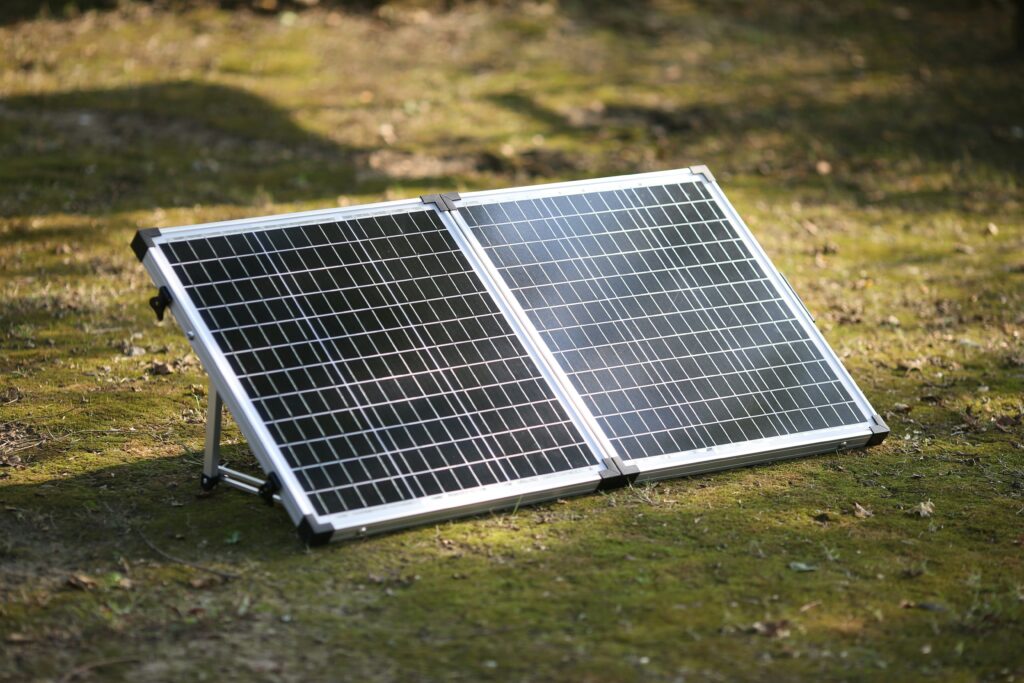
Keeping your phone, GPS, and other devices charged in the backcountry used to mean carefully rationing a single power bank until you reached civilization. Solar charging changes that equation significantly — but only if you pick the right type of charger for your actual use case. The market is flooded with solar power products that make impressive-sounding claims on the box and dramatically underperform in real conditions.
This guide cuts through the marketing to explain the actual difference between solar panels and solar power banks, what the specs really mean for charging speed, and the best options in 2026 for camping, backpacking, and everyday outdoor use.
Solar Panel vs Solar Power Bank: What’s the Difference?
| Solar Panel (no battery) | Solar Power Bank (panel + battery) | |
| How it works | Converts sunlight directly to electricity for connected devices | Converts sunlight and stores it in an internal battery for later use |
| Panel size | Typically larger — 10W to 30W+ | Typically smaller — 5W to 10W |
| Weight | Lighter for same power output | Heavier (includes battery weight) |
| Best use case | Stationary camp charging; always in direct sun | On-the-move charging; cloudy days; charging overnight |
| Charging speed | Faster in direct sun (larger panel) | Slower (smaller panel); USB backup charging available |
| Price | Lower for equivalent output | Higher (pays for battery storage) |
The key insight for backpackers: despite the appeal of a solar panel strapped to your pack while hiking, independent testing consistently shows that panels on a moving backpack produce minimal charge — the panel angle changes constantly, shade from your body and terrain interrupts solar exposure, and the real-world output is a fraction of the rated wattage. Solar panels work best stationary at camp, angled toward the sun. If you mostly hike and camp briefly, a standard (non-solar) high-capacity power bank for the hike and a solar panel to top it up at camp is often more practical than a solar power bank alone.
Best Portable Solar Chargers and Solar Power Banks: Quick Reference
| Product | Type | Output | Weight | Price | Best For |
| BigBlue SolarPowa 28 | Panel only | 28W | 12.3 oz | ~$70 | Best overall camping/backpacking |
| Anker SOLIX PS30 | Panel only | 30W | 14.4 oz | ~$80 | Best brand reputation; fast charge |
| BLAVOR Solar Power Bank | Panel + bank | 10W / 10,000 mAh | ~12 oz | ~$25–35 | Best value solar power bank |
| QiSa Solar Charger | Panel + bank | ~15W / 38,800 mAh | ~2 lbs | ~$55 | Best capacity + wireless charging |
| Hiluckey Outdoor 25000mAh | Panel + bank | 4-panel / 25,000 mAh | ~18 oz | ~$43 | Best rugged solar power bank |
| Anker PowerCore 10000 | Power bank only | No solar / 10,000 mAh | 6.5 oz | ~$30 | Best ultralight non-solar backup |
Best Portable Solar Chargers: Detailed Reviews
1. BigBlue SolarPowa 28 — Best Overall Portable Solar Panel
Type: Panel only | Output: 28W | Weight: 12.3 oz | Price: ~$70
The BigBlue SolarPowa 28 is the top-rated portable solar panel for camping and backpacking in independent testing — producing the highest real-world power output per dollar of any folding panel available in 2026. In testing by OutdoorGearLab, the SolarPowa 28 produced the highest consistent milliamp-hours per hour in direct sun of any panel tested, with dual USB-A outputs capable of simultaneously charging two devices.
The 28-watt output is the practical sweet spot for backpacking: large enough to charge devices meaningfully in direct sun (approximately 2 to 3 hours to fully charge a standard phone), but compact enough to fold into a small bag or clip to the outside of a pack with the included carabiners. The built-in ammeter is a genuinely useful feature that lets you see exactly how much power you’re generating — useful for positioning the panel optimally at camp.
The critical real-world caveat applies here as with all solar panels: mount it stationary at camp angled toward the sun, not flat on a hiking pack. In stationary direct sun conditions, the BigBlue 28 delivers on its rated output more consistently than comparable panels.
- Best for: Backpackers who charge at camp; anyone wanting the best watt-per-ounce solar panel
- Key advantage: Highest real-world output of folding panels in this price range; built-in ammeter
- Limitation: Panel only — no internal battery; requires a separate power bank for cloudy-day or overnight charging
2. Anker SOLIX PS30 — Best Brand Reputation Portable Solar Panel
Type: Panel only | Output: 30W | Weight: ~14.4 oz | Price: ~$80
The Anker SOLIX PS30 is Anker’s entry into the portable solar panel category — a 30-watt foldable panel with dual USB-A and USB-C outputs, monocrystalline cells rated at approximately 23% efficiency, and the brand reliability that Anker has built in the power bank market. For users who are already in the Anker ecosystem (Anker power banks, Anker chargers), the SOLIX PS30 pairs well and the USB-C output provides compatibility with modern devices and Anker’s own power bank range.
The SOLIX PS30 comes with two carabiners for attaching to a pack and a carrying pouch. At $80 it is slightly pricier than the BigBlue SolarPowa 28 for comparable wattage, but Anker’s customer service and warranty reputation are among the strongest in the portable charging category — a meaningful consideration for outdoor equipment that takes real-world abuse.
- Best for: Anker ecosystem users; buyers who prioritize brand warranty and support
- USB-C output: Charges USB-C devices and power banks directly — an advantage over USB-A only panels
3. BLAVOR Solar Charger Power Bank — Best Value Solar Power Bank
Type: Panel + power bank | Solar output: ~5–10W | Capacity: 10,000 mAh | Weight: ~12 oz | Price: ~$25–35
The BLAVOR is the best-selling solar power bank on Amazon and earns its popularity with a strong combination of price, functionality, and build quality for the budget tier. The 10,000 mAh capacity charges most smartphones approximately 2 to 2.5 times from a full charge, the IP65 weatherproof rating provides meaningful protection from rain and splashing water, and the wireless charging pad on the back charges Qi-compatible phones without a cable.
The solar panel on the BLAVOR is small — approximately 5 to 10 watts — which means solar charging is a supplementary feature rather than a primary charging source. In real-world use, a full day of direct sun exposure adds approximately 10 to 20% charge to the internal battery. This is useful for maintaining charge on a multi-day trip where you have some solar exposure, but it will not fully recharge a depleted unit via solar alone. Use USB charging to top up the BLAVOR at town stops; use solar to extend the charge between top-ups.
- Best for: Casual outdoor users; day hikes; travel; anyone wanting solar as a backup feature
- Key advantage: Best price for weatherproof solar power bank with wireless charging; 2–2.5 phone charges from a full bank
- Realistic expectation: Solar adds ~10–20% per day of sun exposure; USB charging is the primary method
4. QiSa Solar Charger — Best High-Capacity Solar Power Bank
Type: Panel + power bank | Solar output: ~15W (4 panels) | Capacity: 38,800 mAh | Weight: ~2 lbs | Price: ~$55
The QiSa is the best option for users who want maximum battery capacity in a solar power bank — a 4-panel foldable design with 38,800 mAh of storage that can charge a standard phone approximately 10 to 12 times from full. The four solar panels provide more solar surface area than single-panel units, resulting in faster solar charging times (still measured in days for a full solar charge, but meaningfully faster than single-panel alternatives).
The QiSa includes wireless charging, two 5V USB outputs, and a USB-C input, alongside a built-in flashlight. The weight (approximately 2 lbs) is significant for backpacking — this is more of a car camping and overlanding unit than a through-hiker’s primary charger. For base camp use, group camping where multiple people share one power source, or emergency preparedness kits, the QiSa’s capacity justifies the weight.
- Best for: Car camping; group camping; extended overlanding; emergency preparedness
- Capacity: ~10–12 phone charges from a full bank
- Limitation: Too heavy for serious backpacking; 2 lbs is significant trail weight
5. Hiluckey Outdoor 25000mAh — Best Rugged Solar Power Bank
Type: Panel + power bank | Solar output: 4-panel | Capacity: 25,000 mAh | Weight: ~18.9 oz | Price: ~$43
The Hiluckey Outdoor 25000mAh is the best-reviewed rugged solar power bank in the mid-range price tier — dust-proof, shock-proof, and waterproof, with a 25,000 mAh capacity that provides approximately 6 to 7 phone charges. The four-panel solar array is meaningfully larger than single-panel units, reducing solar charge time to approximately 25 hours of bright direct sunlight versus 50+ hours for single-panel competitors.
The rugged construction is the key differentiator — drop resistance and waterproofing that holds up in genuine outdoor conditions rather than the IP ratings of more consumer-oriented units. The LED light with SOS mode adds a safety feature that is genuinely useful on remote trips. At approximately 19 ounces, it is on the heavier side for backpacking but manageable for camping and expedition use.
- Best for: Adventure travel; camping in harsh conditions; users who prioritize durability over weight
- SOS mode: LED emergency signal — useful for remote outdoor use
- Note: Some reviews report the unit can drain a connected device when its own battery is very low — avoid charging devices from a nearly depleted unit
6. Anker PowerCore 10000 — Best Lightweight Non-Solar Power Bank for Backpacking
Type: Power bank only (no solar) | Capacity: 10,000 mAh | Weight: 6.5 oz | Price: ~$30
The Anker PowerCore 10000 is included here because it represents the best argument against solar power banks for serious backpackers — at 6.5 ounces and $30, it provides 2 to 2.5 phone charges, charges from USB in 4 to 6 hours, and weighs less than half of any solar power bank with comparable capacity. For through-hikes and backpacking trips where resupply stops provide USB charging every 5 to 7 days, a non-solar power bank used efficiently is lighter and more reliable than carrying a heavier solar bank.
The honest assessment from experienced backpackers: solar power banks are useful as a battery extender with solar as a bonus feature; pure solar panels are useful for camp charging when you have stationary sun exposure. For most backpacking trips with regular town access, the Anker PowerCore plus the BigBlue SolarPowa 28 (used stationary at camp) is a better combination than any solar power bank alone.
How to Choose a Solar Charger: Key Specifications Explained
Wattage (W) — The Most Important Spec
Wattage determines how fast a solar panel generates electricity. Higher wattage = faster charging in direct sun. What each wattage level realistically delivers:
| Wattage | Estimated Charge Time (Phone) | Best Use Case |
| 5W (small bank panel) | 8–12+ hours | Supplemental solar on a power bank; emergency top-up |
| 10–15W | 3–5 hours | Casual camping; day hikes with long stationary breaks |
| 20–28W | 1.5–3 hours | Backpacking; multi-device camping; GPS + phone |
| 30W+ | Under 1.5 hours | Power users; multi-device charging; tablet charging |
Capacity (mAh) — For Power Banks
Milliamp-hours (mAh) is the stored energy in a power bank. Rough conversions:
- 10,000 mAh: approximately 2 to 2.5 full phone charges
- 20,000 mAh: approximately 5 full phone charges
- 25,000 mAh: approximately 6 to 7 full phone charges
- 38,000+ mAh: approximately 10+ phone charges
Note: Actual charges are always less than the mathematical calculation because conversion losses, cable efficiency, and device overhead reduce real-world output by approximately 20 to 30%.
Efficiency Rating (%)
Solar panel efficiency ratings (typically 21 to 24% for monocrystalline panels) indicate how effectively the panel converts sunlight to electricity. Higher efficiency means more power from the same panel area. Monocrystalline panels (the standard in quality portable chargers) are more efficient than polycrystalline alternatives. The efficiency percentage matters most when comparing same-size panels — a 24% efficient panel produces more power in the same conditions than a 20% panel of identical size.
IP Rating — Weatherproofing
IP ratings indicate dust and water resistance. Common ratings for outdoor solar chargers:
- IP65: Dust-tight; protected against water jets from any direction — adequate for rain
- IP67: Dust-tight; protected against immersion up to 1 meter for 30 minutes — good for water sports and heavy rain
- IP68: Dust-tight; protected against continuous immersion beyond 1 meter — most durable rating
The Truth About Solar Charging While Hiking
The most important thing most solar charger reviews won’t tell you: mounting a solar panel flat on a hiking backpack while moving produces minimal charge. Independent testing by Treeline Review and OutdoorGearLab consistently shows that panels in motion generate a fraction of their rated output because:
- Panel angle: Solar panels need to be angled perpendicular to the sun for maximum output. A flat panel on a pack is rarely at the optimal angle.
- Partial shading: Even partial shading from trees, your body, or your pack straps dramatically reduces output — a panel can lose 50% or more of output from 10% shade coverage on certain panel designs.
- Movement: The panel angle changes constantly as you walk, eliminating consistent sun exposure.
The practical conclusion: use solar panels stationary at camp. Set up your panel facing the sun while you make lunch, set up your tent, or rest at a viewpoint. A 30-minute stationary session in bright direct sun with a 28W panel adds more charge than 4 hours of hiking with it on your pack.
Frequently Asked Questions
What is the best portable solar charger?
For a panel-only solar charger (no internal battery), the BigBlue SolarPowa 28 and Anker SOLIX PS30 are the top picks in 2026 — both deliver approximately 28 to 30W of real-world output in direct sun, fold compactly, and include multiple USB outputs. For a solar power bank (panel plus internal battery), the BLAVOR is the best value under $35 and the QiSa is the best high-capacity option under $60.
Are solar power banks worth it for backpacking?
Solar power banks are worth it for backpacking when used as a battery extender rather than a primary charging solution — the solar feature adds useful supplemental charge on sunny trips, while the internal battery provides conventional storage. However, for serious through-hikers, a lightweight non-solar power bank (Anker PowerCore 10000 at 6.5 oz) combined with a separate solar panel used stationary at camp often provides better performance at lower weight than a combined solar power bank. If you have regular town access every 5 to 7 days, a single 10,000 mAh power bank may be all you need.
How long does it take to charge a solar power bank with sunlight?
Charging time via solar depends primarily on the panel size (wattage) and the bank’s capacity. For most solar power banks with small built-in panels (5 to 10W): charging a 10,000 mAh bank fully via solar takes 30 to 50+ hours of direct sunlight. For multi-panel units (15 to 20W panels): 15 to 25 hours of bright direct sun. These are ideal-condition figures — real-world charging takes longer due to partial clouds, suboptimal angles, and efficiency losses. Solar is best used to top up a partially charged bank rather than to fully recharge a depleted one.
What is the best solar charger for camping?
For car camping and base camping, the QiSa (38,800 mAh, 4 panels) provides the best capacity and the Hiluckey Outdoor 25000mAh is the best rugged option. For backpacking camp use, the BigBlue SolarPowa 28 panel combined with an Anker PowerCore power bank provides the best combination of weight, output, and reliability. The BigBlue panels stationary at camp in direct sun deliver approximately 1.5 to 3 hours to a full phone charge depending on sun conditions.
Final Thoughts
The solar charger market in 2026 has genuinely good options at every price point, but the most important purchase decision is choosing the right type for your use case. Panel-only chargers (BigBlue, Anker SOLIX) deliver faster charging and better watt-per-ounce ratios for backpackers who charge at camp. Solar power banks (BLAVOR, Hiluckey, QiSa) are better for casual outdoor users and situations where you need stored power available at any time regardless of sun exposure.
Whatever you choose, set realistic expectations about solar charging speed — the marketing figures assume ideal direct sun with a perfectly angled panel. In typical outdoor conditions, solar charging is a useful supplement to USB-charged power banks, not a replacement for them. Build your charging setup around a reliable primary power bank with solar as the bonus, and you’ll stay powered through any outdoor adventure.