Claw machines are deliberately designed to be difficult — the odds are set against you. But that doesn’t mean winning is impossible. Understanding how the machines work, how claw strength is programmed, and which prizes are positioned to be winnable turns what looks like pure luck into a skill game with significantly better odds.
This guide covers 12 practical tips for winning at claw machines, how claw strength works, what to do when the claw is weak, and specific strategies for Round 1, Dave and Buster’s, GTA 5, and Japanese crane games.
The Truth About Claw Machines: How They’re Set Up
Before diving into strategy, it helps to understand the mechanics working against you:
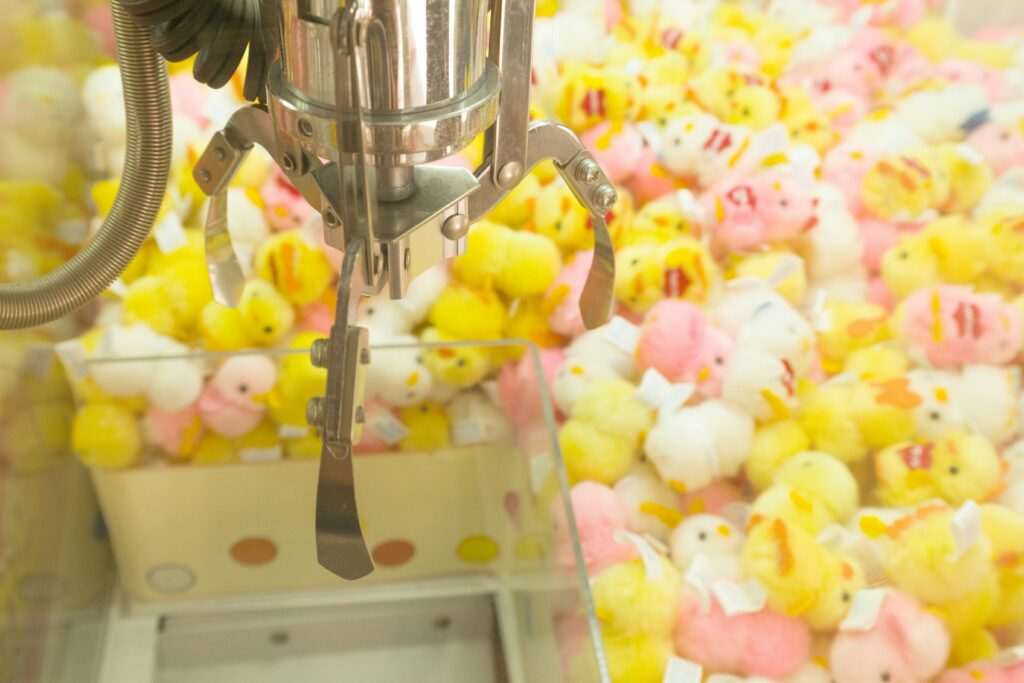
- Claw strength is programmable: Most modern claw machines have electronically controlled claw grip strength. Operators can set the claw to grip at full strength only once every X plays — commonly once every 10 to 15 plays. The rest of the time, the claw grips weakly and drops the prize intentionally.
- This is legal: In the US, claw machines are classified as ‘amusement devices’ rather than gambling machines — as long as the operator discloses (or it is reasonably understood) that the claw may not always work. The payout rate is set to be profitable for the operator.
- Prize positioning matters: Prizes that appear easy to grab (sitting upright, near the chute) are often intentionally placed there by operators to attract play — they are typically positioned so the weak claw drops them just before the chute.
- Budget per prize: Most claw machines are set so the operator earns $5–15 in plays per prize given out. Knowing this helps calibrate your spending expectations.
12 Tips for Winning a Claw Machine
1. Observe Before You Play
Watch the machine for several plays (by other players or by inserting a coin and watching) before committing money. Note whether the claw appears to grip firmly or weakly. If you see the claw drop prize after prize with a visibly loose grip, the machine is likely in a weak cycle and your money is better spent elsewhere or waiting.
2. Choose the Right Prize
Not all prizes are equally winnable. Look for:
- Prizes near the edge of the pile — less weight working against the claw
- Prizes near the chute opening — shorter distance to travel before dropping
- Smaller, lighter prizes — easier for even a weak claw to hold
- Prizes with loops, tags, or handles — a claw can hook through a loop even with weak grip strength
- Prizes that are alone rather than piled — stacked prizes create resistance when the claw tries to lift
3. Aim for the Edge, Not the Center
A common beginner mistake is aiming directly at the center of a prize. A claw that closes over the center of a plush toy rarely lifts it because the weight pulls evenly in all directions. Instead, aim for one side — ideally hooking a corner of the prize so the claw can drag it toward the chute rather than lifting the full weight.
4. Use the ‘Drag to the Chute’ Technique
Instead of trying to lift a prize and carry it all the way to the chute, look for prizes positioned close enough to the chute that you can drag rather than lift. Position the claw at the back of the prize, close, and let the claw push the prize toward the opening as it descends and closes. This technique works especially well with the weak claw setting because it requires minimal grip strength.
5. Win a Claw Machine with a Weak Claw
When the claw is in weak grip mode, lifting is nearly impossible — but winning still is not. Strategies for weak claw machines:
- Target the hook/loop method: Find prizes with attached tags, loops, or ribbon handles. Even a weak claw can hook through a small loop and drag the prize out.
- Stack technique: Use the weak claw to slowly reposition prizes closer to the chute over multiple plays. Think of it as moving pieces across a board. Each play repositions a prize slightly.
- Target small, light prizes: Small keychains, small capsule toys, or compact flat items require significantly less grip force than large plush toys.
- Aim at the tag: The hanging tag on most plush toys can be hooked by a claw prong even with minimal grip pressure.
6. Watch the Drop Zone
Identify exactly where the claw drops prizes into the chute. This point is fixed — the claw always releases at the same location above the chute. Work backward from this point: you want your prize to be positioned so the claw only needs to travel a short distance, minimizing the time the prize is suspended and at risk of falling.
7. Time Your Button Press Precisely
Most claw machines move at a consistent speed. Practice timing your button presses to position the claw with precision rather than reacting at the last moment. Some players watch the claw shadow on the machine floor to judge positioning more accurately than looking at the claw itself from above.
8. Pick Machines That Have Been Recently Restocked
A freshly restocked machine often has prizes positioned in ways that are more winnable — prizes on top of the pile rather than jammed together, and the machine may be in a full-strength cycle to encourage early players. If you see staff restocking a machine, waiting nearby and playing immediately after can improve your odds.
9. Check the Claw Strength Visually
Some machines have a visible tell for claw strength: watch how firmly the claw closes when it reaches the prize platform with no prize under it. If the prongs barely move, the machine is in weak mode. If the prongs close firmly and quickly, the machine may be in a full-strength cycle.
10. Set a Budget Per Machine
Given the programmed payout rate, setting a firm spending limit per machine prevents the sunk-cost trap of spending $30 trying to win a $5 toy. A reasonable budget is $3–5 per machine attempt. If you have not won after that, move on — either to a different machine or a different time.
11. Play When the Machine Is ‘Due’
Since most machines are programmed to pay out on a cycle, a machine that has gone many plays without a win is statistically closer to a full-strength cycle. Machines at busy arcades that get a lot of traffic have these cycles happen faster. Machines at low-traffic locations may go days between full-strength plays.
12. Japanese Claw Machine Technique
Japanese crane games (UFO catchers) use a different mechanical format — two prongs rather than the three or four found in Western claw machines. The technique is different:
- Position one prong inside a loop, handle, or the gap between the prize and the floor
- The goal is usually to flip or roll the prize into the chute rather than lift it
- Japanese operators are generally required to ensure machines are winnable within a reasonable number of plays — staff will often help reposition prizes if you have been playing for a while
- Ask staff for help: In Japanese arcades, asking an attendant for assistance is normal and expected — they can demonstrate the technique or adjust the prize
How to Win at Round 1 Claw Machines
Round 1 Entertainment arcades operate their own claw machines, which tend to be well-maintained and stocked with popular prizes (Squishmallows, anime figures, licensed plush). Round 1-specific tips:
- Round 1 machines are often set to a slightly more generous payout rate than other arcades — they operate at high volume and are interested in player satisfaction
- The ‘two-move’ technique works well at Round 1: use the first move to reposition a prize, and the second move (on the next play) to finish the retrieval
- Round 1 staff are generally responsive to questions about specific machines — asking which machines are currently set to a good payout is sometimes worth trying
- Focus on lighter prizes (small plush, keychains) rather than the large stuffed animals on the top layer
How to Win the Claw Machine at Dave and Buster’s
Dave and Buster’s claw machines use a ticket/chip economy. Key differences from standalone arcades:
- Dave and Buster’s machines use Power Cards rather than coins — check your Power Card balance before extended play
- The machines tend to be higher-quality mechanically, with consistent claw behavior
- D&B often features machines with smaller, denser prizes (capsules, small toys) that are more winnable with weak claw settings
- Check the ticket prize redemption store — sometimes the prize in the claw machine costs more tickets/chips in plays than the equivalent item costs in the redemption store. Always check redemption prices first.
How to Win the Claw Machine in GTA 5
In GTA 5 and GTA Online, the Shiny Wasabi Kitty claw machine is found in the Lucky Wheel area of the Diamond Casino & Resort. The GTA claw machine works differently from real machines:
- The GTA claw machine is a skill-based minigame — the claw strength is not randomized the way real machines are
- Position the claw directly over the kitty plush and drop straight down — the claw grips firmly if positioned correctly
- The challenge is precise positioning: use the camera angle to judge your X and Y position carefully before pressing the button
- If you miss, you can replay immediately — there is no real-money cost in GTA, only in-game currency
- The prize (Shiny Wasabi Kitty plush for your apartment) requires a direct center drop on the toy
Claw Machine Strategy by Prize Type
| Prize Type | Difficulty | Best Strategy |
| Small plush / keychain | Easiest | Direct lift; target the tag or loop |
| Squishmallow (medium) | Moderate | Hook one side; drag to chute |
| Large stuffed animal | Hard | Reposition over multiple plays; edge technique |
| Capsule / small toy | Easy-moderate | Aim for edge; drag method |
| iPhone / electronics | Very hard | Machine often rigged; very high cycle count |
| Cash/bills | Hard | Usually folded; target edge of folded bills |
Frequently Asked Questions
How do you win a claw machine every time?
Winning every single time is not realistic — claw machines are programmed with a set payout rate and the claw grip is electronically weakened for most plays. However, you can significantly improve your odds by: choosing prizes near the chute, using the drag technique instead of lifting, targeting prizes with loops or tags that a weak claw can hook, and only playing machines that appear to be in or near a full-strength cycle.
Are claw machines rigged?
Technically yes — the claw grip strength is deliberately reduced for most plays to control the payout rate. This is legal in the US as long as the machines are classified as amusement devices. The machines are not random; they are programmed to pay out at a specific rate set by the operator, typically once every 10–20 plays. Understanding this is the first step to playing strategically rather than randomly.
How do you win a claw machine with a weak claw?
With a deliberately weakened claw, lifting prizes directly is nearly impossible. Instead: target prizes with loops, tags, or handles that a prong can hook through; use the drag technique to push prizes toward the chute; target the lightest, smallest prizes; or use multiple plays to gradually reposition a prize closer to the chute until the machine enters a full-strength cycle.
How do you win at Round 1 claw machines?
Round 1 machines tend to be generous compared to many independent arcades. Focus on lighter prizes, use the two-play repositioning technique, and target prizes near the chute opening. Round 1 staff are generally helpful and may answer questions about specific machines.
Final Thoughts
Claw machines are a combination of skill and programmed odds. The skill component — choosing the right prize, using the drag technique, targeting loops and tags — can meaningfully improve your win rate beyond pure luck. But no strategy overcomes a machine that is deep in a weak-claw cycle. The most practical approach is to observe before spending, set a firm budget, use the drag and hook techniques, and walk away from machines that show no signs of being in a generous cycle. Save your money for machines and moments where the odds are actually in your favor.