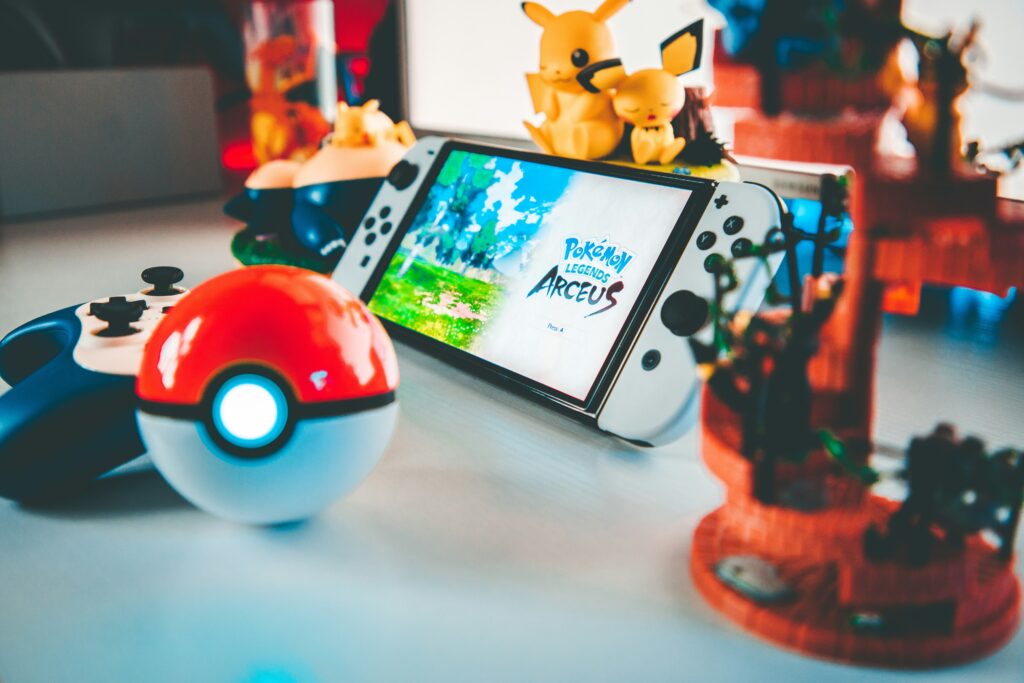
The Nintendo Switch has now hosted the most diverse lineup of mainline best Pokemon games in franchise history — spanning traditional remakes, experimental spin-offs, open-world adventures, and an entirely new approach to the series formula that changed what Pokemon games can be. With Pokemon Z-A confirmed for 2026 and the Switch 2 on the horizon, now is the perfect time to rank every mainline Switch Pokemon game and break down which ones are actually worth your time.
This ranking covers all mainline Pokemon games released on Nintendo Switch, assessed across story, exploration, gameplay mechanics, replay value, and how they hold up in 2026. Every game is worth playing for different reasons — and every game has genuine weaknesses worth knowing before you buy.
All Mainline Pokemon Switch Games: Quick Reference
| Game | Release | Metacritic | Play Time | Best For |
| Pokemon Legends: Arceus | Jan 2022 | 83 | 25–80 hrs | Action-adventure Pokemon fans; open-world lovers |
| Pokemon Let’s Go Pikachu/Eevee | Nov 2018 | 76–79 | 15–40 hrs | Kanto nostalgia; families; casual players |
| Pokemon Scarlet/Violet | Nov 2022 | 72–73 | 35–100 hrs | Open-world exploration; online battlers |
| Pokemon Sword/Shield | Nov 2019 | 80 | 25–80 hrs | Social/multiplayer; DLC content |
| Pokemon Brilliant Diamond/Shining Pearl | Nov 2021 | 73–74 | 25–50 hrs | Sinnoh fans; completionists |
The Ranking: Every Mainline Pokemon Switch Game
5. Pokemon Brilliant Diamond and Shining Pearl — The Most Faithful Remake
Release: November 2021 | Developer: ILCA | Metacritic: 73–74
Pokemon Brilliant Diamond and Shining Pearl occupy an interesting spot in the franchise’s history — remakes so faithful to the 2006 originals that they left barely any footprint of their own. Developed by ILCA (not Game Freak), the games rebuilt the Sinnoh region in 3D with Pokemon following the player and an expanded Grand Underground with roaming Pokemon in distinct biomes. For players whose only Sinnoh experience was the original Diamond or Pearl rather than the superior Pokemon Platinum, the remakes represent a genuine improvement.
The problems, however, are hard to ignore. The Grand Underground — one of the remakes’ headline additions — removed the social interaction that made the original feature compelling. The original Underground allowed Capture the Flag, trap-setting, and proper Secret Base customization. The remake reduced Secret Bases to displaying Pokemon statues. A lively-looking multiplayer space with no real multiplayer activity.
Ramanas Park added 14 legendary Pokemon, but the shard-farming grind to unlock them through underground exploration is tediously slow. TMs are still single-use — in a game released in 2021. Mythical Pokemon like Darkrai and Shaymin were event-locked for a limited window, with Mew and Jirachi requiring save files from other Switch games. Every time something promising appears, a frustrating design decision follows immediately behind it.
- Best for: Players who only experienced Diamond or Pearl originally and never played Platinum
- Skip if: You’ve played Pokemon Platinum — these remakes don’t add what Platinum already improved
- Notable: The game is mechanically competent and the Sinnoh region looks genuinely good in 3D
4. Pokemon Sword and Shield — The Controversial Starting Point
Release: November 2019 | Developer: Game Freak | Metacritic: 80
Pokemon Sword and Shield arrived with the biggest controversy in franchise history: Dexit. For the first time in a mainline generation, not all Pokemon would be transferable to the new game, with 234 Pokemon cut from the National Pokedex. The backlash was significant. Looking back, however, Dexit was arguably the least of the game’s problems.
The linear design of the Galar region is the bigger issue — routes that feel more like corridors than explorable zones, with side paths that lead to little of note. The Wild Area introduced open-world ambition but delivered limited depth: roaming Pokemon and Max Raid Dens provide the main activities, and the area loses its appeal quickly without more to discover.
The DLC expansions — The Isle of Armor and The Crown Tundra — addressed most of these problems. The Crown Tundra in particular is excellent, introducing new Legendary Pokemon including Galarian forms of the Kanto bird trio and the Dynamax Adventures co-op mode. But these required a $30 additional purchase on top of the base game’s $60, and without them the post-game is notably thin. The Battle Tower, for players who enjoy end-game challenge facilities, is disappointingly shallow compared to facilities from earlier games.
What Sword and Shield do well: Galar is beautiful, especially its starting area. The new Pokemon designs are memorable. Gigantamax forms are visually striking. Playing Max Raid Dens with friends during launch was a genuinely social experience. The game set the stage for what would follow in the next generation — you can see Game Freak working toward something better, even if this wasn’t quite it.
- Best for: Social/multiplayer Pokemon; Crown Tundra DLC is the highlight; new Pokemon designs
- Skip if: You care primarily about deep single-player challenge — the difficulty scaling is poor throughout
- Notable: Crown Tundra + Isle of Armor DLC bundle significantly improves the base experience
3. Pokemon Scarlet and Violet — The Bold Open World
Release: November 2022 | Developer: Game Freak | Metacritic: 72–73
Pokemon Scarlet and Violet represent the most ambitious mainline Pokemon game Game Freak has ever attempted and simultaneously the most technically troubled launch in franchise history. The Paldea region is a genuine open world — not the curated Wild Area of Sword and Shield or the segmented zones of Legends: Arceus, but an interconnected map where you can head in any direction from the first minutes after the prologue.
The three separate storylines (Gym Badges, Path of Legends, Starfall Street) can be tackled in any order, and this structural freedom is genuinely exciting. The new Pokemon — including Koraidon and Miraidon as rideable legendary mounts — are well designed. The lore of Area Zero and the Paradox Pokemon is among the best storytelling the series has produced. Online battling in Generation IX is the deepest and most competitively balanced in years.
But the technical reality undercut all of it. Two and a half years after launch, performance issues persist — frame rate drops, pop-in, and visual inconsistencies that no patch has fully resolved. Towns are small and feel emptier than those in games made fifteen years earlier. The 12 cities and towns feel minutes apart, removing the sense that Paldea is a real-scale region. Wild Pokemon level distribution creates bizarre situations where very high-level Pokemon appear in starter areas.
The Teal Mask and Indigo Disk DLC both extend the experience meaningfully, but required another $35 investment and both rely on the player already invested enough to push through the base game’s technical roughness. Scarlet and Violet are genuinely great when they work — the problem is they don’t always work.
- Best for: Open-world Pokemon exploration; story and lore depth; competitive online battling
- Skip if: Technical imperfection genuinely bothers you — the performance issues are real and persistent
- Notable: The Indigo Disk DLC has some of the best post-game content in the franchise
2. Pokemon Let’s Go Pikachu and Eevee — The Unexpected Gem
Release: November 2018 | Developer: Game Freak | Metacritic: 76–79
Pokemon Let’s Go Pikachu and Let’s Go Eevee were received with skepticism when announced — the first mainline Pokemon games on a home console, arriving when everyone expected a new generation, presented as Pokemon Go-adjacent titles targeting casual players. The criticism was understandable. Wild battles were removed. Catching involved Pokeball throwing via motion controls. The difficulty was minimal. The targeted audience was clearly different from the core fanbase.
What the critics underestimated was how much Let’s Go gets right in ways that matter. Kanto — the original 151 Pokemon region — rebuilt in HD with Pokemon visible in the overworld at appropriate sizes (an Onix is actually large, not child-sized), following the player, rideable through the region. For anyone who spent childhood hours with Pokemon Red or Blue, the visual realization of Kanto in the style Let’s Go achieves is genuinely moving.
The catching mechanic, initially criticized, becomes satisfying with practice — particularly when using the Pokeball Plus controller, which makes catching feel physical and immediate. The Partner Pokemon (Pikachu or Eevee depending on version) are unusually powerful and access unique moves, which does make the game easy, but the Candy system and the joy of seeing Pokemon follow you everywhere compensate substantially. Shiny hunting is the most accessible it has ever been in any Pokemon game — chaining encounters surfaces shinies at a rate that feels rewarding rather than grind-like.
Let’s Go is the Pokemon game you introduce to children, to non-gamers, or to anyone who loved the original games and wants to revisit Kanto without the commitment of a full traditional Pokemon experience. It is also, genuinely, the best-looking mainline Pokemon game on the Switch.
- Best for: Kanto nostalgia; families; introducing Pokemon to younger players; shiny hunters
- Skip if: You want a traditional challenge-based Pokemon experience — this is deliberately easy
- Notable: Best visual presentation of any mainline Switch Pokemon game; Pokeball Plus integration is excellent
1. Pokemon Legends: Arceus — The Best Pokemon Game on Switch
Release: January 2022 | Developer: Game Freak | Metacritic: 83
Pokemon Legends: Arceus is the best mainline Pokemon game on the Nintendo Switch and the most genuinely original game the franchise has produced since its earliest years. Set in a historical version of Sinnoh — the Hisui region, predating modern Pokemon training conventions — Legends: Arceus discards the traditional gym structure entirely and presents Pokemon catching and battling as an adventure with actual stakes.
The fundamental change is how catching works. Pokemon roam the environments in real time, behaving differently depending on species and disposition — some flee, some attack. You approach them in real time, throw Pokeballs directly to attempt a catch without a battle, or send your own Pokemon to weaken them first. When a Pokeball connects and the catch succeeds, the visual and audio feedback is immediately satisfying in a way that no previous Pokemon game managed. The throw has genuine weight and trajectory.
Traversal is another genuine success — riding Wyrdeer across grasslands, climbing with Sneasler, diving with Basculegion, gliding with Braviary — each traversal Pokemon unlocked progressively and all switchable fluidly on the fly. Getting around Hisui never becomes tedious.
Alpha Pokemon — oversized, more powerful versions of species found in each zone — create genuine moments of environmental danger that the series has never had before. Walking into a new area and encountering an Alpha Garchomp before you have the Pokemon to handle it is a meaningful experience. Boss battles against Noble Pokemon are action sequences requiring dodge-and-response timing rather than turn-based menu navigation.
The game’s weaknesses are real: the visual quality struggles on Switch hardware, with rough textures and occasional frame drops in busy areas. Towns are sparse. The storyline is linear, though engaging. Shaymin and Darkrai require save files from other games. None of these undermine the core experience, which delivers what Pokemon games have been gesturing toward for a decade: a world that feels alive, where catching Pokemon feels like an accomplishment, and where exploration has genuine stakes.
- Best for: Anyone who has wanted Pokemon to evolve beyond its traditional structure; action-adventure fans
- Notable: Metacritic 83 — highest-rated Switch Pokemon mainline game by critical consensus
- Skip if: You specifically want a traditional gym-based Pokemon journey — Legends is structurally different
Best Pokemon Games: Who Should Play What
| Player Type | Recommended Starting Game |
| First-time Pokemon player | Pokemon Let’s Go Pikachu/Eevee — most accessible; visual quality outstanding |
| Returning fan from Gen 1/Kanto | Pokemon Let’s Go Pikachu/Eevee — Kanto rebuilt beautifully |
| Wants the best Pokemon experience overall | Pokemon Legends: Arceus — most innovative; highest rated |
| Open world RPG fan | Pokemon Scarlet/Violet — true open world; best story |
| Competitive/online battler | Pokemon Scarlet/Violet — deepest Generation IX meta |
| Sinnoh fan (Diamond/Pearl) | Pokemon Brilliant Diamond/Shining Pearl — faithful Sinnoh remake |
| Wants multiplayer focus | Pokemon Sword/Shield — Max Raids; Crown Tundra co-op |
| Parent introducing Pokemon to a child | Pokemon Let’s Go — Pokeball Plus; easy difficulty; charming |
Pokemon Switch Games: Key Differences Explained
Traditional vs Non-Traditional Pokemon Games
The Switch lineup includes both traditional gym-based Pokemon games and non-traditional entries. Traditional games (Sword/Shield, Scarlet/Violet, Brilliant Diamond/Shining Pearl) follow the established formula: choose a starter, progress through routes and towns, challenge eight Gym Leaders, defeat the Elite Four. Non-traditional entries (Legends: Arceus, Let’s Go) depart significantly from this structure.
The Let’s Go games removed wild battles and focused on motion-control catching. Legends: Arceus removed gyms entirely and replaced them with zone-based research tasks and Noble Pokemon boss battles. Neither is inherently better or worse — they serve different audiences.
Open World vs Linear Pokemon
Pokemon Scarlet and Violet represent the series’ first true open-world design — no fixed route order, no level scaling, full freedom of movement from the start. Legends: Arceus uses a semi-open design with distinct unlockable zones. Sword and Shield’s Wild Area is an open area within a linear game. Brilliant Diamond and Shining Pearl are the most linear entry, following the Sinnoh map essentially as designed in 2006.
For players who value exploration freedom, Scarlet/Violet offers the most of any mainline title. For players who prefer a guided, structured experience, Brilliant Diamond/Shining Pearl is the most traditional choice.
Post-Game and End-Game Content
- Pokemon Legends: Arceus: Pokedex completion quests; Alpha Pokemon hunting; post-story area unlocks
- Pokemon Scarlet/Violet: Competitive online battling; Indigo Disk DLC; Tera Raids
- Pokemon Sword/Shield: Crown Tundra DLC; Dynamax Adventures; online battling
- Pokemon Brilliant Diamond/Shining Pearl: Grand Underground; Ramanas Park legendaries; Battle Tower
- Pokemon Let’s Go: Master Trainer challenges (one for each of the original 151 Pokemon); Shiny hunting
Frequently Asked Questions
What is the best Pokemon game?
For most players in 2025, Pokemon Legends: Arceus is the best Pokemon game on Nintendo Switch — it holds the highest Metacritic score (83) of any mainline Switch Pokemon title, introduces the most genuinely innovative mechanics in the franchise’s recent history, and delivers a sense of adventure and real-time interaction with Pokemon that traditional games have never managed. If you only play one Switch Pokemon game, Legends: Arceus is the one.
What is the best Pokemon game for beginners?
Pokemon Let’s Go Pikachu or Eevee is the best Pokemon game for beginners and younger players. The accessible catching mechanics, simplified structure, outstanding visuals, and optional Pokeball Plus controller make it the most immediately enjoyable and least overwhelming entry point. Pokemon Sword and Shield is the best choice for players who want a more complete traditional Pokemon experience as their first game.
What is the best Pokemon game on Nintendo Switch for competitive play?
Pokemon Scarlet and Violet has the deepest and most current competitive battling system of any Switch Pokemon game. Generation IX’s Terastallization mechanic, the expanded Pokedex, and the active online community make it the right choice for players interested in competitive team-building and online battles. The lack of an offline battle facility is a meaningful limitation, but for pure online competitive play, Scarlet/Violet is the clear pick.
Are Pokemon Scarlet and Violet worth buying despite the technical issues?
Yes, with caveats. Two years after launch, many of the worst performance issues have been patched, though some persist. The base game’s story, open-world exploration, new Pokemon designs, and lore are genuinely excellent. The Indigo Disk DLC adds significant value. If you can tolerate occasional frame drops and visual inconsistencies in exchange for the franchise’s most ambitious open-world design and best story, Scarlet and Violet are worth playing. If technical polish is a priority, Legends: Arceus is the better-running alternative.
Is Pokemon Legends: Arceus a mainline Pokemon game?
Yes — Game Freak and Nintendo classify Pokemon Legends: Arceus as a mainline Pokemon title, not a spin-off. It uses the mainline game’s Pokemon mechanics, features the mainline Pokedex, and supports Pokemon Home transfer. The structural departure from traditional gym-based gameplay is a design choice, not a spin-off designation. Metacritic critics and the Pokemon Company itself treat it as part of the mainline series.
Final Thoughts
The Nintendo Switch Pokemon lineup spans five years of the franchise in transition — from the cautious, connectivity-focused Let’s Go games through Sword and Shield’s Wild Area experiment to Scarlet and Violet’s full open-world commitment, with Legends: Arceus as the boldest single departure the franchise has made in decades. No two of these games feel the same.
If there’s one consistent recommendation: start with Pokemon Legends: Arceus if you want the best single Pokemon game on Switch, or Pokemon Let’s Go if you want the most accessible and beautiful one. The rest of the lineup has genuine strengths and genuine weaknesses — and knowing both before buying saves disappointment and sets the right expectations for whichever Pokemon world you choose to step into.