“Can my 3D printer print metal?” is one of those questions with an answer that depends entirely on what’s actually meant by it. There’s a huge difference between a desktop FDM printer extruding metal-filled filament and an industrial machine fusing metal powder with lasers – and the cost difference is just as dramatic. Here’s how metal (and carbon fiber) 3D printing actually works across that spectrum, and what each approach realistically costs.
Two Completely Different Things Called “Metal 3D Printing”
When people search for a “3D printer that prints metal,” they’re usually thinking of one of two very different processes:
- Desktop FDM with metal-filled filament: A standard-looking FDM printer extrudes filament that’s a mix of plastic (usually PLA) and a high percentage of metal powder – sometimes 80% or more by weight. The printed part comes out looking and feeling metallic, but isn’t yet a true metal part.
- Industrial powder-bed metal printing: Specialized industrial machines use lasers to fuse metal powder directly, layer by layer, producing genuinely solid metal parts without any plastic involved. This is an entirely different (and vastly more expensive) category of equipment.
These two processes serve very different purposes, and confusing them leads to very different expectations about cost, capability, and what the final part will actually be.
Desktop Metal-Filled Filament: How It Works
Metal-filled filaments are typically a PLA base mixed with a high percentage of metal powder – copper, bronze, steel, or even titanium. Printed straight off the printer, these parts have a noticeably heavier feel and a surface that can be sanded and polished to a genuine metallic shine, making them popular for decorative items, jewelry, and sculptures where the look and weight of metal matters more than functional metal properties.
For parts that need to behave like actual metal – structural strength, conductivity, heat resistance – the printed part needs to go through sintering: a post-processing step where the plastic binder is burned away in a furnace, leaving behind a dense metal part. This is the same general principle used in metal injection molding, adapted for 3D printed “green parts.” Sintering requires specialized equipment beyond the printer itself, and not all metal-filled filaments have been validated for sintering – titanium filaments in particular are described by some manufacturers as not yet having documented sintering trials, making them more suited to decorative use until that changes.
Hardware Requirements for Metal-Filled Filament
Printing metal-filled filament successfully on a desktop FDM printer requires some specific hardware considerations, since the abrasive metal particles can wear down standard components quickly:
- Hardened or stainless steel nozzles: Standard brass nozzles wear out quickly when printing abrasive metal-filled filament; a 0.6mm or 0.8mm hardened nozzle is commonly recommended
- All-metal hot ends with direct-drive extruders: Dual-gear, direct-drive setups provide more consistent feeding for these denser, less flexible filaments
- No filament drying: Unlike standard PLA, some metal-filled filaments are less prone to absorbing moisture, and manufacturers specifically warn against using filament dryers with certain metal filaments, as drying can have adverse effects
What Metal Filament Costs
| Filament Type | Approx. Cost | Notes |
| Standard PLA/PETG | $20-$30/kg | Baseline comparison |
| Copper/bronze metal filament | $25-$45/kg (composite) up to $120+/kg (sinterable) | Most accessible metal-filled option |
| Titanium filament (~80% metal) | $450-$565/kg | Premium tier, decorative use; sintering not yet broadly validated |
The cost gap between “composite” metal filaments (designed mainly for aesthetics and weight) and “sinterable” filaments (designed to become functional metal parts after post-processing) is significant – composite options can cost a fraction of sinterable ones, reflecting the different metal content and processing pathway each is designed for.
Industrial Metal Printing: A Different World Entirely
True industrial metal 3D printing – the kind that produces aerospace and medical components – uses powder-bed systems where lasers selectively fuse metal powder layer by layer inside a controlled chamber, often under an inert gas atmosphere to prevent oxidation. These machines handle materials including titanium, aluminum, stainless steel, and exotic alloys like Inconel, with build volumes that can reach 400mm cubed or more on higher-end systems using multiple lasers simultaneously for faster builds.
The cost structure here is fundamentally different from filament-based printing. As of 2026, titanium 3D printing through industrial services typically runs $5-$20 per cubic centimeter of finished part – and notably, the raw powder cost (roughly $300-$600/kg) isn’t actually the primary expense. Machine time is. Industrial metal printers represent enormous capital investments, and that cost gets reflected in per-part pricing regardless of how much material a given part actually uses.
- Machine uptime accounts for roughly 40-70% of total cost
- Post-processing (support removal, heat treatment, surface finishing) accounts for another 20-50%
- A tall or solid part often costs more than a complex, lightweight lattice structure of similar mass, because print time – driven by height and density – matters more than raw material weight
This means that for industrial metal printing, design choices that reduce print time (hollowing parts, topology optimization, orienting parts to minimize vertical height) can meaningfully reduce cost – sometimes by 30-50% according to cost-optimization guides.
Carbon Fiber 3D Printing: A Related but Different Category
Carbon fiber 3D printing gets grouped with metal printing in search behavior, but it’s a distinct category with its own two-tier structure: chopped fiber and continuous fiber.
Chopped carbon fiber filament is a thermoplastic (commonly PETG or nylon) infused with short carbon fiber strands, typically costing around $50/kg for a standard 1kg spool. These filaments produce parts that are stiffer and more dimensionally stable than plain plastic – though the added fiber also makes parts more brittle, trading some impact resistance for rigidity. Printing chopped carbon fiber filament requires a hardened nozzle, similar to metal-filled filaments, since the fiber strands are abrasive to standard brass nozzles.
Continuous fiber systems are a different proposition entirely – these lay down unbroken strands of carbon fiber alongside the plastic matrix, producing parts that can rival machined aluminum in strength along the fiber direction. Specialized continuous-fiber filaments can cost significantly more per spool than chopped alternatives, reflecting the more complex material and the more capable printer hardware required to use it. Some of the most advanced continuous-fiber desktop systems use robotic tool-changing architecture to combine fiber placement with standard FDM printing in a single machine, supporting advanced matrix materials like PEEK and PEKK for parts that need to withstand high temperatures.
Dual Extruders: Why They Matter for Advanced Materials
Dual extruder printers – machines with two separate print heads or nozzles – serve a particularly useful role for both metal-filled and carbon fiber printing. One common setup pairs a hardened nozzle (for the abrasive metal or carbon fiber filament) with a standard nozzle running water-soluble support material, allowing complex geometries to be printed with supports that dissolve away cleanly afterward rather than needing to be manually removed from hard-to-reach areas.
For carbon fiber specifically, some 2026 printers pair a direct-drive hardened nozzle for the fiber-filled material with a separate Bowden-style nozzle for support material, letting a single machine handle both the demanding print material and the cleanup material without compromise on either.
Ceramic 3D Printing
Ceramic 3D printing follows a similar pattern to metal-filled filament: ceramic-loaded filaments or resins can be printed on appropriately equipped machines, producing a “green” part that then requires firing in a kiln to become a true ceramic object – similar in concept to traditional pottery, but starting from a 3D printed shape rather than hand-formed clay. As with sinterable metal filaments, this requires equipment beyond the printer itself (in this case, a kiln capable of reaching ceramic firing temperatures), making it a more involved process than printing standard plastics.
Which Option Makes Sense for You?
- Want a metallic look and feel for decorative items or props: Composite metal-filled filament on a hardened-nozzle desktop printer is the accessible entry point
- Need genuinely functional metal parts: Either sinterable filament plus access to sintering equipment, or an industrial metal printing service – the latter being far more common given the equipment investment sintering requires
- Want stronger, stiffer parts for functional prototypes: Chopped carbon fiber filament on a hardened-nozzle printer is a well-established, relatively accessible option
- Need parts that rival machined metal in strength: Continuous fiber systems, though these represent a significant step up in both equipment cost and complexity
What Is FDM, and Why Does It Matter Here?
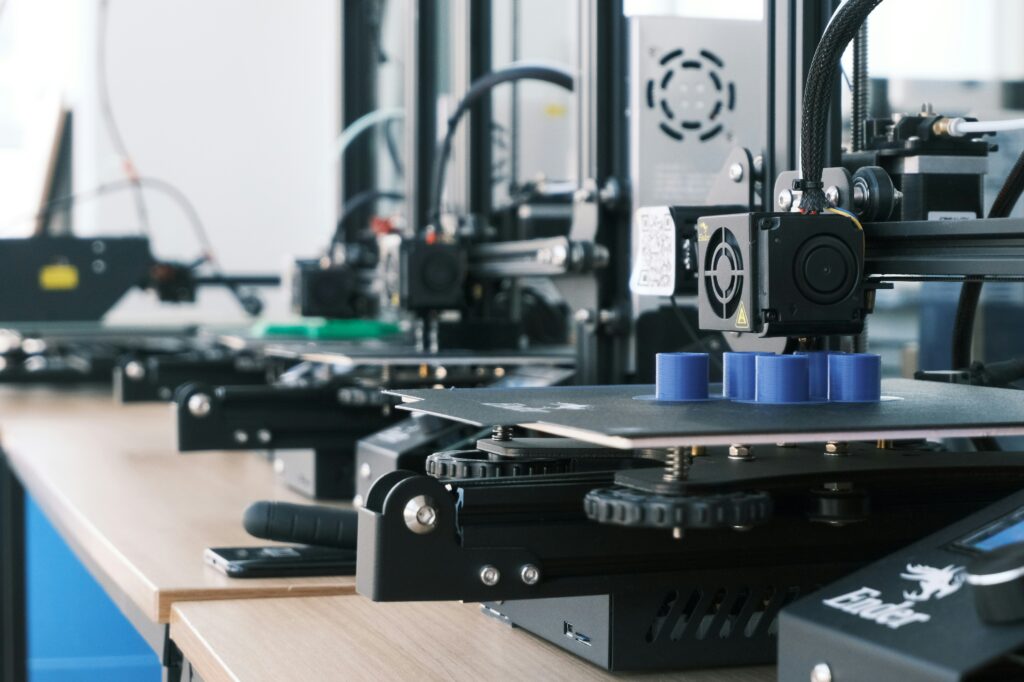
FDM (Fused Deposition Modeling) is the most common type of desktop 3D printing – the process of melting plastic filament and extruding it layer by layer through a heated nozzle to build up an object. It’s the technology behind the vast majority of consumer and prosumer 3D printers, including every metal-filled filament and carbon fiber filament printer discussed in this article.
Understanding FDM matters here because it’s the common thread connecting otherwise very different materials. The same basic FDM process – a heated nozzle extruding filament layer by layer – can run standard PLA, metal-filled composites, carbon fiber blends, or ceramic-loaded filaments, with the main differences coming down to nozzle hardness, extruder design, and whether the printed part needs additional post-processing (sintering, firing, or neither) to reach its final intended properties.
This is also why FDM printers occupy such a wide price range – a basic FDM printer for standard PLA can cost under $200, while an FDM printer properly equipped for carbon fiber or metal-filled filament (hardened nozzles, all-metal hot ends, sometimes an active heated chamber) sits in a meaningfully higher tier, even though the underlying printing process is fundamentally the same.
Frequently Asked Questions
Can a regular 3D printer print metal?
A standard FDM printer can print metal-filled filament (plastic mixed with metal powder) if equipped with a hardened nozzle, producing parts with a metallic look and feel. True functional metal parts require additional sintering equipment, or an entirely different industrial powder-bed printing process.
What is the difference between metal-filled filament and industrial metal 3D printing?
Metal-filled filament is plastic mixed with metal powder, printed on modified FDM printers and optionally sintered afterward to become functional metal. Industrial metal printing uses lasers to fuse metal powder directly into solid metal parts, with no plastic involved – a fundamentally different and far more expensive process.
How much does titanium 3D printing cost?
Industrial titanium 3D printing typically costs $5-$20 per cubic centimeter of finished part as of 2026. Titanium filament for desktop printers costs roughly $450-$565/kg, though sintering for these filaments isn’t yet broadly validated, making them mainly suited to decorative use.
Do I need a special nozzle for carbon fiber or metal filament?
Yes – both metal-filled and carbon fiber filaments are abrasive and will wear down standard brass nozzles quickly. A hardened steel or stainless steel nozzle (commonly 0.6mm or 0.8mm) is recommended for either material.
What’s the difference between chopped and continuous carbon fiber?
Chopped carbon fiber filament contains short fiber strands mixed into the plastic, improving stiffness at a relatively accessible cost. Continuous fiber systems lay down unbroken fiber strands, producing parts that can rival machined aluminum in strength along the fiber direction, at significantly higher cost and complexity.
What is FDM, and is it the same as metal 3D printing?
FDM (Fused Deposition Modeling) is the process of extruding melted filament layer by layer – the technology behind most desktop 3D printers. It’s not the same as industrial metal 3D printing, but FDM printers can run metal-filled filament when equipped with the right hardware, which is the desktop entry point into metal-look 3D printing.
Final Thoughts
“Metal 3D printing” covers an enormous range – from a $50 spool of copper-filled filament on a hardened-nozzle desktop FDM printer, all the way to industrial laser-powder systems where machine time alone can cost more than most people’s entire 3D printing setup combined. The honest starting point for anyone exploring this space is figuring out which of these very different things they actually need: a metallic look and feel for a decorative project, genuinely functional metal parts for an engineering application, or something in the carbon fiber middle ground that trades a bit of metal’s properties for a far more accessible price point and a desktop-friendly process.