Not all arcade games involve a joystick and buttons — the arcade format spawned an enormous range of specialized experiences: basketball machines you shoot real hoops at, golf arcade simulators, driving cabinets with force-feedback steering wheels, light gun shooters, rhythm games, skee ball lanes, and fighting game tournaments. This guide covers the best arcade games by genre including basketball machines, sports arcades, shooting games, fighting games from the 80s and 90s, zombie arcade games, and the full landscape of modern and classic arcade formats.
For the complete classic arcade games guide — 80s list, greatest of all time, and home arcade machine buying guide — see our article on the best classic arcade games, 80s list, greatest of all time, and home arcade machines.
Arcade Basketball Machines — Basketball Game Arcade Style
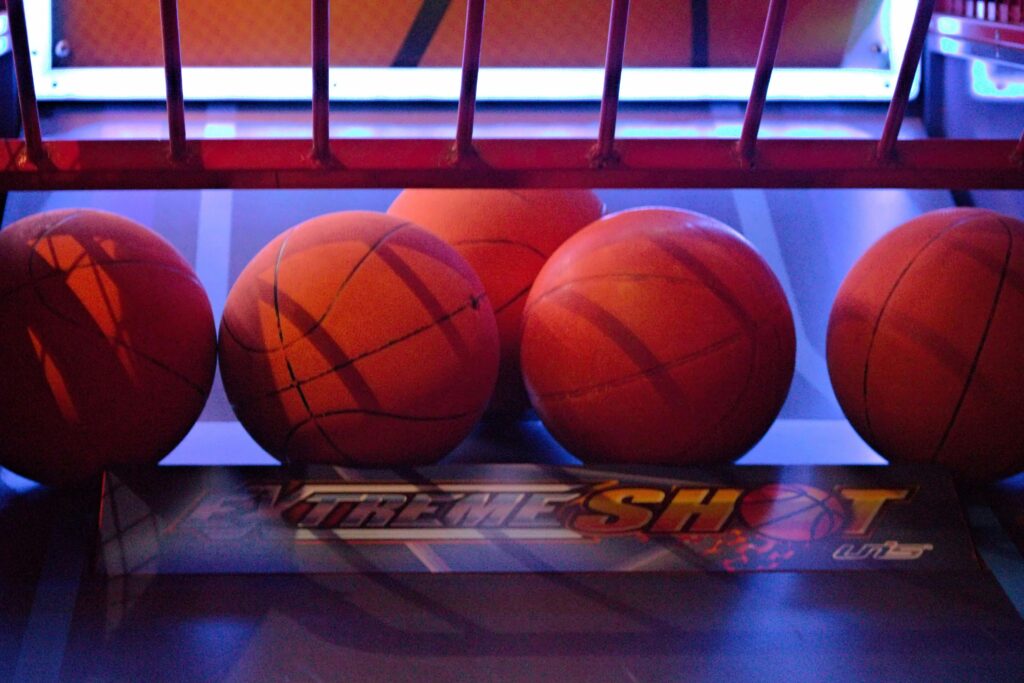
Arcade basketball machines (officially called ‘arcade basketball games’ or ‘skee basketball’) are the most popular redemption and sports arcade machines in modern arcades. Players shoot real miniature basketballs at a hoop within a time limit to score as many points as possible — tickets are awarded based on score.
| Machine | Manufacturer | Notes |
| Pop-A-Shot | Pop-A-Shot | Most popular home basketball arcade; dual-hoop model available |
| NBA Hoops | Coastal Amusements | Most common in commercial arcades; ticket redemption |
| Basketball Pro | Andamiro | Two-player competitive; escalating hoop distance |
| Shoot to Win | Betson Enterprises | Tournament-style; leaderboard scoring |
| Fast Break | Global VR | Standing or seated; multiple difficulty modes |
Electronic Basketball Arcade Game — Home Options
For home basketball arcade games, the Pop-A-Shot dual-hoop model ($250-400) is the most popular choice — two players compete simultaneously at adjacent hoops, making it excellent for parties and game rooms. Smaller tabletop basketball games ($30-80) are available at Walmart and Target for less serious play. The NBA Jam Arcade1Up cabinet ($400) brings arcade NBA basketball to home gaming in digital form, though it is a video game rather than a physical hoop machine.
Arcade Sports Games — Golf, Soccer, Football, and Fishing
Golf Arcade Game — Golden Tee
Golden Tee is the dominant golf arcade game franchise — it has been present in bars and arcades since Golden Tee Golf (1989) and remains actively updated with new courses annually. Players use a trackball to control swing power and direction. Golden Tee Live cabinets in bars and restaurants connect to an online network — players compete against others across the country in real time. The Golden Tee home edition ($599-799) brings the trackball golf experience to home game rooms. Golden Tee is the most financially successful non-redemption arcade game still operating in bars — its online community is active with dedicated tournaments and leagues.
Soccer Arcade Game
- Kick It (Konami, 1995): Four-player soccer arcade with dramatic overhead view
- Virtua Striker series (Sega): First fully 3D soccer arcade game; fast arcade-style gameplay
- Super Sidekicks series (SNK): Classic 2D soccer arcade; popular in Japan
- FIFA Street (arcade conversion): Streetball-style soccer with tricks and skills
Football Arcade Game
- Blitz: The League (Midway): The definitive football arcade machine — 2-player, full-contact, over-the-top football
- NFL Blitz (Midway, 1997): Original arcade football game; 7-on-7 with late hits and unlockable teams
- Cyberball (Atari, 1988): Robot football with an exploding ball — early 80s football arcade
Buck Hunter Arcade Game
Big Buck Hunter Pro (Play Mechanix / Raw Thrills) is the most installed hunting arcade game in North American bars and arcades. Players use light gun controllers to shoot deer, elk, moose, and other animals while avoiding ‘doe’ shots that cost points. Big Buck Hunter is available in multiple cabinet configurations including the standard upright cabinet (most common in bars) and the Big Buck World edition with international hunting locations. The game consistently ranks among the top-grossing non-fighting arcade games in the bar-venue market. A home edition (Big Buck Hunter Reloaded for Nintendo Switch and PC) brings the experience to home gaming.
Skee Ball Arcade Game
Skee-ball is one of the oldest and most persistent arcade games — the original Skee-Ball Alley launched in 1909. Players roll balls up a ramp and into scored rings, with the small center ring awarding the most tickets. Skee-ball is the dominant redemption arcade game category at most entertainment venues. Home skee-ball machines ($200-600) are available from companies like Triumph Sports and Skeeball Inc. — standard home lanes are 9 feet long (slightly shorter than commercial 13-foot arcade lanes). Ice Cold Beer is a popular bar variant where players control a horizontal bar to roll a ball into a series of progressively higher holes — it remains one of the most beloved skill-based arcade games.
Arcade Driving Games
Arcade driving games are a distinct category featuring dedicated cabinets with steering wheels, gas/brake pedals, and force-feedback systems that provide physical resistance matching in-game collisions and road texture. The genre pioneered immersive hardware long before home racing games caught up.
| Game | Year | Why It’s Important |
| OutRun | 1986 (Sega) | First sit-down cabinet with force-feedback; Ferrari 328 GTS; radio choice |
| Daytona USA | 1993 (Sega) | Linked cabinet network; 8-player simultaneous; most played racing arcade |
| Hydro Thunder | 1999 (Midway) | Powerboat racing; massive cabinets; explosive shortcuts |
| Initial D Arcade Stage | 2002 (Sega) | Japanese street racing; card save system; still running in Japan |
| Fast & Furious | 2004 (Raw Thrills) | Accessible film tie-in; twin-cabinet setup common |
| Mario Kart Arcade GP | 2005 (Namco/Nintendo) | Nintendo characters in full motion cabinet |
Shooting Arcade Games — Light Guns and Rail Shooters
Light gun arcade games use specialized gun peripherals that detect where on the screen the player is pointing — allowing physical aiming at targets. This genre peaked in the 1990s and produced some of the most intense arcade experiences ever made.
- House of the Dead (Sega, 1996): Zombie rail shooter; two-player cooperative; spawned multiple sequels
- Time Crisis (Namco, 1995): Cover mechanic via foot pedal; tense enemy countdown timers; Time Crisis II is peak of genre
- Area 51 (Atari, 1995): Alien shooter with motion-captured enemy animations; two-player
- Terminator 2: Judgment Day (1991): First Terminator arcade game; impressive for its time; two-player shooting
- Operation Wolf (Taito, 1987): First major light gun game to use a machine gun controller rather than pistol
- Die Hard Arcade (Sega, 1996): Beat-em-up with shooting elements; two-player cooperative
- Mad Dog McCree (American Laser Games, 1990): FMV-based light gun western — real video footage with gun targets
Fighting Arcade Games — 80s and 90s Fighters
Best 90s Fighting Arcade Games
| Game | Year | Why It Defined the Era |
| Street Fighter II: The World Warrior | 1991 | Defined competitive fighting; 8 playable characters; combo system |
| Mortal Kombat | 1992 | Fatalities; realistic digitized sprites; controversially violent |
| Tekken (1994-1995) | 1994 | 3D fighting; T-bone steak name origin; Namco’s answer to Virtua Fighter |
| Street Fighter Alpha 2 | 1996 | Art style shift; air blocking; Custom Combos |
| Marvel vs. Capcom | 1998 | Tag-team fighting; chaotic; most rewatchable fighting game |
| King of Fighters ’98 | 1998 | SNK’s best KOF; 3-on-3 team fighting; beloved competitively |
| Gauntlet Legends | 1998 | Action-RPG arcade; 4-player; character progression between sessions |
Arcade Fighting Games — 90s vs Modern
The 90s fighting arcade game golden age (1991-1999) produced more iconic titles per year than any other period in gaming. Street Fighter II’s 1991 release triggered a fighting game explosion — every major Japanese publisher rushed fighting game entries into arcades. The format peaked around 1994-1995 when Tekken, Virtua Fighter 2, and Killer Instinct competed simultaneously. Modern arcade fighting games (2010s-2020s) are primarily found at Japanese arcades (Round1, Taito stations) — games like Street Fighter V Arcade Edition and Under Night In-Birth run on dedicated cabinets that connect to online leaderboards.
Zombie Arcade Games
- House of the Dead series (Sega): Most prolific zombie arcade franchise — HotD, HotD2, HotD3, HotD4, all featuring rail-shooter zombie combat with cooperative play
- Resident Evil: The Umbrella Chronicles / Darkside Chronicles (Capcom): RE universe zombie rail shooters
- Silent Scope (Konami): Sniper rifle peripheral; terrorist and zombie-adjacent targets
- The Typing of the Dead (Sega): Keyboard instead of gun controller — type words to kill zombies; extremely distinctive
- Zombie Revenge (Sega): Beat-em-up zombie game spinoff of House of the Dead universe
Marvel Arcade Games
- X-Men (Konami, 1992): 6-player arcade beat-em-up; most expensive Konami cabinet; X-Men characters with signature moves
- The Punisher (Capcom, 1993): 2-player beat-em-up; Punisher and Nick Fury co-op
- Captain America and the Avengers (Data East, 1991): 4-player beat-em-up; all major Avengers
- Marvel vs. Capcom series (Capcom, 1994-2000): Tag-team fighting game crossover; Marvel Super Heroes then MvC1 and MvC2
- Spider-Man: The Video Game (Sega, 1991): 4-player action arcade; beat-em-up with side-scrolling
Konami Arcade Games — The Best of the Konami Catalog
- Teenage Mutant Ninja Turtles (1989): 4-player beat-em-up; TMNT’s defining game; widely considered the best licensed arcade game ever made
- Aliens (1990): 2-player light gun shooter based on the film; excellent sprite work
- X-Men (1992): 6-player arcade — biggest Konami cabinet
- The Simpsons (1991): 4-player Simpsons beat-em-up; humorous level design; beloved
- Sunset Riders (1991): 2 or 4-player western shooter; vibrant colors; excellent music
- Contra (1987): The definitive run-and-gun arcade game; Konami code origin
- Gradius (1985): Horizontal shooter; ‘Options’ power-up system; still considered peak shooter design
Pokemon Arcade Games
Pokemon has appeared in several arcade formats over the years:
- Pokemon: Mezastar (2021-present): Japanese arcade collectible card game — players earn character-printed plastic medallions by battling; extremely popular in Japan
- Pokemon Tretta (2012-2015): Previous Pokémon arcade coin battle game in Japan; coin-based RPG
- Pokemon Snap (1998 arcade version): Photography-based Pokemon game; limited US arcade release
- Pokemon Trading Card Game: Various arcade adaptations of the TCG in Japan
Most dedicated Pokemon arcade games are Japan-exclusive. In Western arcades, Pokemon IP appears primarily in prize machines and claw games rather than dedicated video arcade cabinets.
2-Player Arcade Games — Best Co-op and Competitive
Best 2-Player Cooperative Arcade Games
- TMNT: Turtles in Time (Konami, 1991): Best 2-player cooperative arcade beat-em-up ever made
- Final Fight (Capcom, 1989): Classic side-scrolling beat-em-up; Metro City setting
- Contra (Konami, 1987): Two-player run-and-gun; the Konami code origin
- X-Men (Konami, 1992): 2 to 6-player cooperative; most versatile arcade co-op
- House of the Dead 2 (Sega, 1998): Best zombie light gun co-op; smoother pacing than HotD1
Best 2-Player Competitive Arcade Games
- Street Fighter II (Capcom, 1991): Defined competitive two-player arcade gaming
- Mortal Kombat (Midway, 1992): Two-player fighting with fatalities
- NBA Jam (Midway, 1993): 2-on-2 basketball arcade; ‘He’s on fire!’ — still played
- Golden Tee Golf: Two-player competitive golf trackball
- Pop-A-Shot Basketball: Dual-hoop simultaneous basketball shooting competition
Star Wars Arcade Games
- Star Wars (Atari, 1983): First-person vector graphics X-wing battle; cockpit or upright cabinet; groundbreaking voice samples
- Star Wars Trilogy Arcade (Sega, 1998): Three Star Wars film episodes; force-feedback flight stick; 6DOF cockpit motion cabinet
- Star Wars Battle Pod (Bandai Namco, 2014): Modern 180-degree dome screen arcade; most immersive Star Wars arcade ever made; 5 missions from the original trilogy
- Star Wars: Battle for Nabula (2000): Pod racing arcade based on Episode I
Arcade Emulators — Playing Arcade Games at Home
Arcade emulators allow you to run classic arcade games on modern hardware:
- MAME (mamedev.org): The gold-standard arcade emulator — runs tens of thousands of arcade ROMs with high accuracy; available for Windows, Mac, Linux; open source
- RetroArch: Multi-system emulator frontend that includes MAME and FinalBurn Neo cores for arcade emulation; user-friendly interface
- FinalBurn Neo (FBNeo): More focused than MAME; better for 2D fighters (CPS1/CPS2/Neo Geo); faster emulation
- Flycast: Best Dreamcast and Naomi arcade emulator — runs Crazy Taxi, Virtua Fighter 3, House of the Dead 2
- Model 2 Emulator: Best for Sega Model 2 arcade games (Virtua Fighter 2, Daytona USA, Virtua Racing)
Hacked Arcade Games — Cheat Codes and Modifications
‘Hacked arcade games’ or ‘arcade hacked games’ typically refers to browser-based arcade games (unblocked hacked games) or modified ROM versions of classic arcade games. Cheat codes and modifications for classic arcade ROMs are available through MAME — these can unlock infinite lives, access debug menus, or enable features normally locked. The most famous arcade game hack is the ‘Ms. Pac-Man hack’ that transformed Pac-Man into Ms. Pac-Man through a kit sold directly to arcade operators. Bootleg arcade boards — unauthorized ROM copies of popular games — were widespread in the 80s and 90s, particularly in Asia, and created unique regional variations of popular titles.
Arcade Games in Wreck-It Ralph — Real Arcade References
Disney’s Wreck-It Ralph (2012) is set inside arcade game cabinets and features numerous real arcade game references: Fix-It Felix Jr. (the fictional game Ralph is from, styled after Donkey Kong), Q*bert and Q*bert characters appear prominently in the film, Pac-Man’s ghost Clyde appears, the Street Fighter characters Ryu and Ken appear, Sonic the Hedgehog makes a cameo with a PSA about dying outside your own game, and the Sugar Rush game is modeled after kart racing games like Candy Crush and Mario Kart arcade cabinets. The film’s arcade bar setting (Litwak’s Arcade) accurately depicts late-era US arcades with a mix of classic cabinets and ticket redemption machines.
For classic arcade game history, 80s arcade lists, home arcade machine buying guide, and playing classic games online, see our guide to the best classic arcade games — 80s list, greatest of all time, and home arcade machine guide.
For arcade game specifications and release history, see Arcade History — complete arcade game database. For the best arcade emulator, see MAME — Multiple Arcade Machine Emulator official site.
For the best action and open world games including fighting games and gaming history, see our guide to the best action games by genre — horror, roguelike, hack-and-slash, and more.
Bottom Line
| Best basketball arcade machine | Pop-A-Shot (home) or NBA Hoops (commercial) |
| Best golf arcade game | Golden Tee (still in bars; home edition available) |
| Best hunting arcade game | Big Buck Hunter Pro — most-installed bar arcade game |
| Best shooting arcade game | Time Crisis II or House of the Dead 2 |
| Best 90s fighting arcade game | Street Fighter II or Mortal Kombat 2 |
| Best Konami arcade game | TMNT (1989) — greatest licensed arcade game ever |
| Best Marvel arcade game | X-Men (1992, 6-player) or Marvel vs. Capcom 2 |
| Best zombie arcade game | House of the Dead 2 (Sega, 1998) |
| Best 2-player co-op arcade | TMNT: Turtles in Time (Konami, 1991) |
| Best arcade emulator | MAME (mamedev.org) — runs 10,000+ arcade ROMs |
Frequently Asked Questions
What are the best arcade basketball machines?
The best arcade basketball machines for commercial use are NBA Hoops (Coastal Amusements) and Basketball Pro (Andamiro) — both widely installed in Dave & Buster’s, Round1, and Chuck E. Cheese. For home use, Pop-A-Shot is the top recommendation — the dual-hoop model ($250-400) lets two players compete simultaneously and is sized for home game rooms. Electronic basketball arcade machines combine a physical hoop with an electronic scoring and timer system, awarding tickets in commercial settings. NBA Jam (Midway, 1993) is the best digital basketball arcade game if you want video gaming rather than physical shooting.
What are the best shooting arcade games?
The best shooting arcade games are Time Crisis II (Namco, 1997 — best light gun game ever made with foot pedal cover mechanic), House of the Dead 2 (Sega, 1998 — best zombie shooter with cooperative play), Area 51 (Atari, 1995 — classic alien shooter), and Terminator 2: Judgment Day (1991 — iconic licensed shooter). For modern shooting arcades still found in commercial venues: Raw Thrills’ Target Terror and Big Buck Hunter Pro remain popular. All these games feature dedicated light gun hardware that makes the experience fundamentally different from playing shooting games at home.
What are the best 90s fighting arcade games?
The best 90s fighting arcade games are Street Fighter II: The World Warrior (1991 — defined the genre), Mortal Kombat and Mortal Kombat II (1992-1993 — fatalities, controversy, and excellent gameplay), Street Fighter Alpha 2 (1996 — refined and beautiful), Marvel vs. Capcom (1998 — chaotic tag-team), King of Fighters ’98 (SNK — 3-on-3 team fighting perfection), and Tekken 3 (1997 — the peak 3D fighter). The 90s produced more arcade fighting game classics per year than any other era — most remained in active competitive play well into the 2000s and are still played today at retro gaming events.
What are the best Konami arcade games?
The best Konami arcade games are Teenage Mutant Ninja Turtles (1989 — arguably the greatest licensed arcade game ever made; 4-player beat-em-up), The Simpsons (1991 — 4-player; humorous; excellent), Sunset Riders (1991 — 2/4 player western shooter; great soundtrack), X-Men (1992 — 6-player; most versatile Konami beat-em-up), Contra (1987 — the run-and-gun template), and Gradius (1985 — the horizontal shooter that influenced every shooter after it). Konami dominated the beat-em-up and licensed arcade game category throughout the late 1980s and early 1990s.