‘Pilot Training Flight Simulator’ means two very different things depending on who you ask. For the Roblox community, it refers to one of Roblox’s most popular aviation games — a free-to-play game where you fly planes, earn badges, and unlock aircraft. For aspiring real pilots, it refers to home flight simulator software used to supplement actual flight training.
This guide covers both: a complete Roblox Pilot Training Flight Simulator guide (fastest planes, controls, map, badges, tips), followed by the best real pilot training flight simulators for actual aviation training.
PART 1: Pilot Training Flight Simulator (Roblox Game)
What Is Pilot Training Flight Simulator on Roblox?
Pilot Training Flight Simulator (PTFS) is one of the oldest and most played aviation games on Roblox, created by OctoMan_Dev. Players spawn at airports, choose aircraft from a hangar, and fly across a large open map that includes multiple airports, islands, cities, and landmarks. The game is free to play with some premium aircraft available for purchase with Robux.
Key features: multiple aircraft types (commercial jets, military jets, propeller planes, helicopters), realistic flight physics for a Roblox game, multiplayer with other players at the same airports, badge system for achievements, and missions.
Pilot Training Flight Simulator Controls (PC)
| Control | Action |
| W / Up Arrow | Increase throttle / pitch nose down |
| S / Down Arrow | Decrease throttle / pitch nose up |
| A / Left Arrow | Roll left / rudder left |
| D / Right Arrow | Roll right / rudder right |
| Q | Yaw left (rudder) |
| E | Yaw right (rudder) |
| G | Toggle landing gear up/down |
| F | Toggle flaps |
| B | Toggle brakes |
| Space | Throttle up (some aircraft) |
| Shift | Throttle down / fine control |
| C | Toggle camera view |
| X | Eject (some aircraft) |
Mobile controls: PTFS has an on-screen joystick and button layout for mobile players. The game is playable on mobile but PC is recommended for precision flying.
Fastest Planes in Pilot Training Flight Simulator
Speed is one of the most popular aspects of PTFS — players constantly seek the fastest aircraft for crossing the map quickly or for the thrill of high-speed flight.
| Aircraft | Type | Cost | Speed Rank |
| SR-71 Blackbird | Military jet | Robux (paid) | Fastest in game |
| Concorde | Supersonic commercial | Robux (paid) | 2nd fastest |
| F-22 Raptor | Fighter jet | Robux (paid) | Top free-tier speed |
| B-2 Spirit | Stealth bomber | Robux (paid) | Fast military |
| 737 MAX | Commercial | Free | Fastest free commercial |
| Cessna 172 | Propeller | Free | Slowest — beginner |
Fastest free plane: Among the free aircraft, larger commercial jets like the Boeing 737 variant are the fastest free options. The SR-71 Blackbird is the undisputed fastest aircraft in PTFS but requires Robux.
Fastest jet overall: The SR-71 Blackbird is consistently cited as the fastest plane in Pilot Training Flight Simulator. The Concorde is a close second and offers the unique experience of a supersonic commercial airliner.
Pilot Training Flight Simulator Map
The PTFS map is a large island chain with multiple airports and landmarks:
- International Airport (main hub): The largest airport on the map; most players spawn here; has the longest runways
- Mayfield Airport: Secondary airport; smaller and quieter than the main hub
- Military Base: Features a carrier launch pad and military-specific areas
- Island airports: Several smaller airstrips across the map for short-hop flying
- Cities and landmarks: The map includes city areas, bridges, mountains, and ocean zones
The map has been updated multiple times since the game launched. The carrier launch feature allows naval-style jet launches from a short runway section — a popular challenge for players.
How to Carrier Launch in Pilot Training Flight Simulator
The carrier launch is one of the most exciting features in PTFS:
- Step 1: Spawn at or fly to the Military Base area
- Step 2: Select a fast jet (fighter jet recommended — the catapult assists takeoff but you still need speed)
- Step 3: Position your aircraft on the carrier launch pad/catapult
- Step 4: Apply full throttle before the launch sequence
- Step 5: The catapult will assist in launching the aircraft at high speed — pull back on the stick immediately after launch to achieve positive climb rate
Tip: High-speed jets work best for carrier launches. Slower propeller aircraft or large commercial jets will struggle even with the catapult assist.
Pilot Training Flight Simulator Badges
PTFS has a badge system rewarding specific achievements:
- First Flight: Complete your first flight and landing
- Speed Demon: Reach a specific speed threshold (varies by update)
- Frequent Flyer: Complete a set number of flights
- Around the World: Visit all airports on the map
- Carrier Landing: Successfully land on the carrier deck
- High Altitude: Reach a high altitude milestone
Badges are earned automatically when conditions are met — no special action is required beyond completing the objective.
How to Play Pilot Training Flight Simulator on Mobile
PTFS is available on Roblox mobile (iOS and Android) through the Roblox app:
- Download the Roblox app and log in to your account
- Search ‘Pilot Training Flight Simulator’ in the Roblox search bar
- Tap Play — the game will load with mobile-specific on-screen controls
- Use the virtual joystick on the left side of the screen for flight control and the on-screen buttons for throttle, gear, and flaps
PTFS on mobile is functional but more challenging than PC due to the smaller control interface. Larger tablets provide a better mobile experience than phones.
Can You Play Pilot Training Flight Simulator on Xbox?
Yes — Roblox is available on Xbox, and PTFS is playable on Xbox through the Roblox Xbox app. Controls are mapped to the Xbox controller. The game performance on Xbox is generally solid, though complex maneuvers may be slightly harder with a controller than with keyboard+mouse.
Pilot Training Flight Simulator Tips for Beginners
- Start with the Cessna 172 or another small propeller plane to learn basic flight controls before moving to jets
- Use the main International Airport for takeoffs — it has long runways that give you more room to accelerate and get airborne
- Landing is harder than takeoff: reduce throttle early, deploy flaps (F key), lower gear (G key), and approach at a shallow angle
- Use camera mode (C key) to switch between cockpit and third-person views — third person is often easier for beginners
- Other players are not enemies — PTFS is generally a cooperative game environment
- The game autosaves your aircraft unlocks and badge progress to your Roblox account
PART 2: Best Flight Simulators for Real Pilot Training
Do Real Pilots Use Flight Simulators for Training?
Yes — flight simulators are a core component of professional pilot training. The FAA recognizes several levels of flight simulation devices: Full Flight Simulators (FFS) used by airlines for type rating training, Flight Training Devices (FTD), and Aviation Training Devices (ATD) approved for logging simulator hours toward a pilot certificate.
For student pilots at home, consumer flight simulators are not FAA-approved for logging hours, but they are widely used for instrument procedure practice, approach familiarization, and building general flying intuition — all of which accelerate actual training.
Best Flight Simulators for Pilot Training at Home
| Simulator | Price | Platform | Best For |
| Microsoft Flight Simulator 2024 | ~$60–120 | PC/Xbox | Best overall realism; commercial pilot training |
| X-Plane 12 | ~$60 | PC/Mac/Linux | FAA-approved ATD add-ons available; professional standard |
| Prepar3D (P3D) | ~$60 | PC | Professional/military training standard |
| DCS World | Free base | PC | Military aviation; very high fidelity |
| Infinite Flight | Subscription | iOS/Android | Best mobile option; good for IFR practice |
Microsoft Flight Simulator for Pilot Training
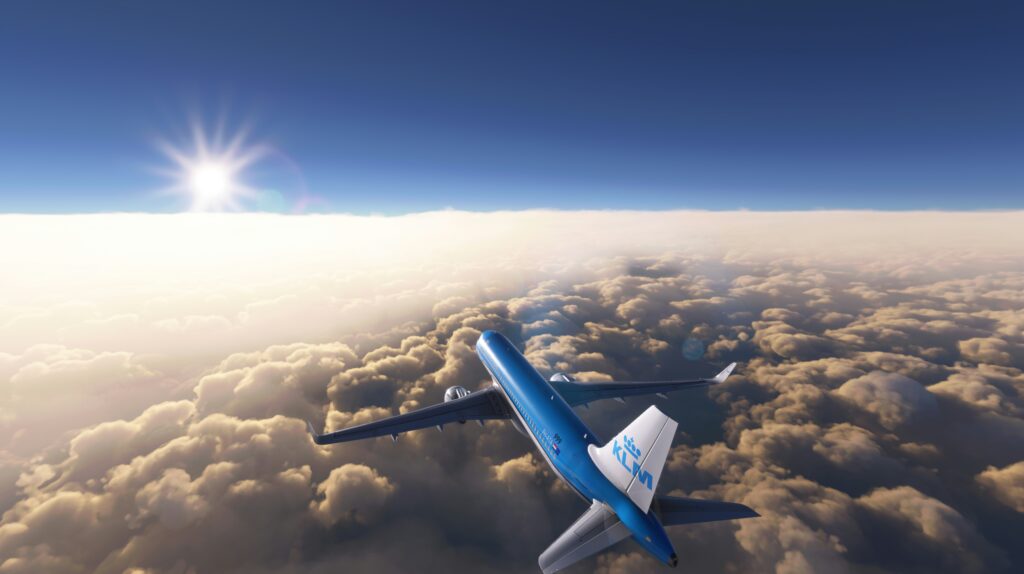
Microsoft Flight Simulator 2024 is the most visually realistic consumer flight simulator available and uses real-world weather data, satellite imagery, and aerodynamic models. For pilot training purposes:
- Good for: Familiarization with real airports, IFR approach practice, instrument panel layout, ATC communication practice, general procedural awareness
- Limitations: Not FAA-approved for logging hours without specific ATD hardware configurations; the default aircraft physics, while impressive, are not identical to real aircraft
- Add-ons that improve training value: Professional pilot training courses (e.g., from Navigraph, PilotEdge for live ATC), study-level aircraft models (PMDG, Fenix)
Real pilots widely use MSFS for currency maintenance and procedure review, even if it does not count for official logged hours.
X-Plane 12 for Pilot Training
X-Plane is the simulator most widely used in professional and FAA-recognized training contexts. Its flight model (blade element theory) is considered more aerodynamically accurate than MSFS, which matters for training purposes. Several X-Plane configurations with appropriate hardware qualify as FAA-approved Aviation Training Devices.
- Best for: Private pilot and instrument rating students who want the most accurate flight physics
- ATD qualification: With certified hardware configurations, X-Plane can be used to log FAA-recognized training hours
- Recommended add-ons: Zibo 737 (free, highly detailed Boeing 737), ForeFlight integration, PilotEdge for live ATC
Home Simulator Hardware for Pilot Training
- Yoke or joystick: Honeycomb Aeronautical Alpha Flight Controls yoke (~$250) is the most popular entry-level option for fixed-wing training
- Rudder pedals: Thrustmaster TFRP (~$100) or Honeycomb Bravo rudder pedals — essential for realistic aircraft control
- Throttle quadrant: Honeycomb Bravo Throttle Quadrant (~$250) — simulates multi-engine power management
- Multi-monitor setup: Multiple monitors or a curved ultrawide improve situational awareness
- VR headset: Meta Quest 3 or similar — highly immersive; some pilots prefer VR for approach training
Frequently Asked Questions
What is the fastest plane in Pilot Training Flight Simulator (Roblox)?
The SR-71 Blackbird is the fastest aircraft in Pilot Training Flight Simulator on Roblox. It is a paid aircraft requiring Robux. The Concorde is the second fastest and also paid. Among free aircraft, the larger commercial jets (Boeing 737-type aircraft) are the fastest options available without spending Robux.
What are the controls for Pilot Training Flight Simulator?
On PC: W/S control throttle and pitch, A/D control roll, Q/E control rudder yaw, G toggles landing gear, F toggles flaps, B applies brakes, and C switches camera view. On mobile, on-screen virtual controls are provided. On Xbox, controls are mapped to the controller buttons.
Is Microsoft Flight Simulator good for pilot training?
Microsoft Flight Simulator is an excellent supplement to real pilot training — useful for airport familiarization, instrument approach practice, procedure review, and ATC communication practice. It is not FAA-approved for logging training hours without specific certified hardware. X-Plane 12 with certified hardware is the better choice for loggable simulator time.
What is the best flight simulator for private pilot training?
X-Plane 12 is the most widely recommended for private pilot training due to its accurate flight model and availability in FAA-approved Aviation Training Device configurations. Microsoft Flight Simulator 2024 is the best for visual realism and airport familiarization. Both are valuable — many student pilots use MSFS for visual training and X-Plane for instrument work.
Final Thoughts
Whether you’re chasing the SR-71 speed record in the Roblox Pilot Training Flight Simulator or practicing ILS approaches in Microsoft Flight Simulator 2024 for your PPL training, flight simulation is one of gaming’s most rewarding niches. The Roblox game offers an accessible, free introduction to aviation concepts for all ages, while consumer-grade PC simulators like X-Plane and MSFS provide genuine value for student pilots looking to build procedural fluency between real lessons.